

When Absorbency Is Not Enough: The Fit Gap in Adult Incontinence Underwear
Adult incontinence products are often compared by absorbency. But a product can hold a large amount of liquid in a test and still disappoint in daily life if it gaps at the legs, loosens at the crotch or shifts during movement. New consumer research suggests that this gap between protection, fit and real-life stability has not disappeared.
What the latest consumer data actually says
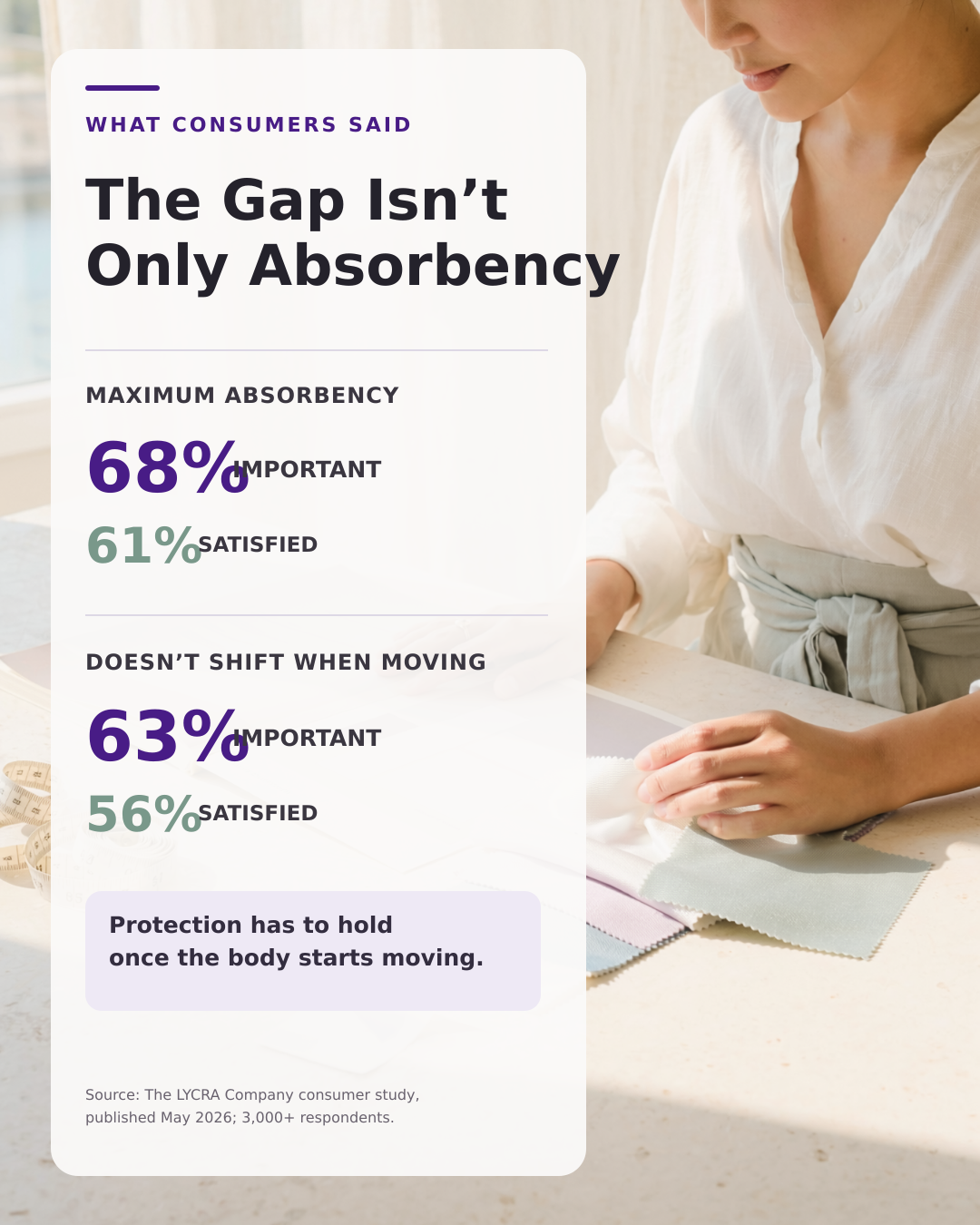
In May 2026, The LYCRA Company published findings from research conducted with Walnut Unlimited among more than 3,000 consumers of adult incontinence products. The results did not point to one isolated complaint. Instead, they showed unmet expectations across both protection and wear experience.
Maximum absorbency: 68% considered it important, while 61% were satisfied with existing products.
Doesn’t shift when moving: 63% considered it important, while 56% were satisfied.
These figures need to be read carefully. The 68% and 61% values refer to maximum absorbency—not directly to fit. The movement-related result is 63% versus 56%. Together, however, they reveal a useful product-development question: are users receiving both the absorption they need and the stability required to keep that protection in the right place?
That distinction matters because leakage is not always evidence that the absorbent core is too small. The product may have enough theoretical capacity, yet fail to maintain contact with the body as the wearer walks, sits, bends or exercises.
Fit is part of leak protection
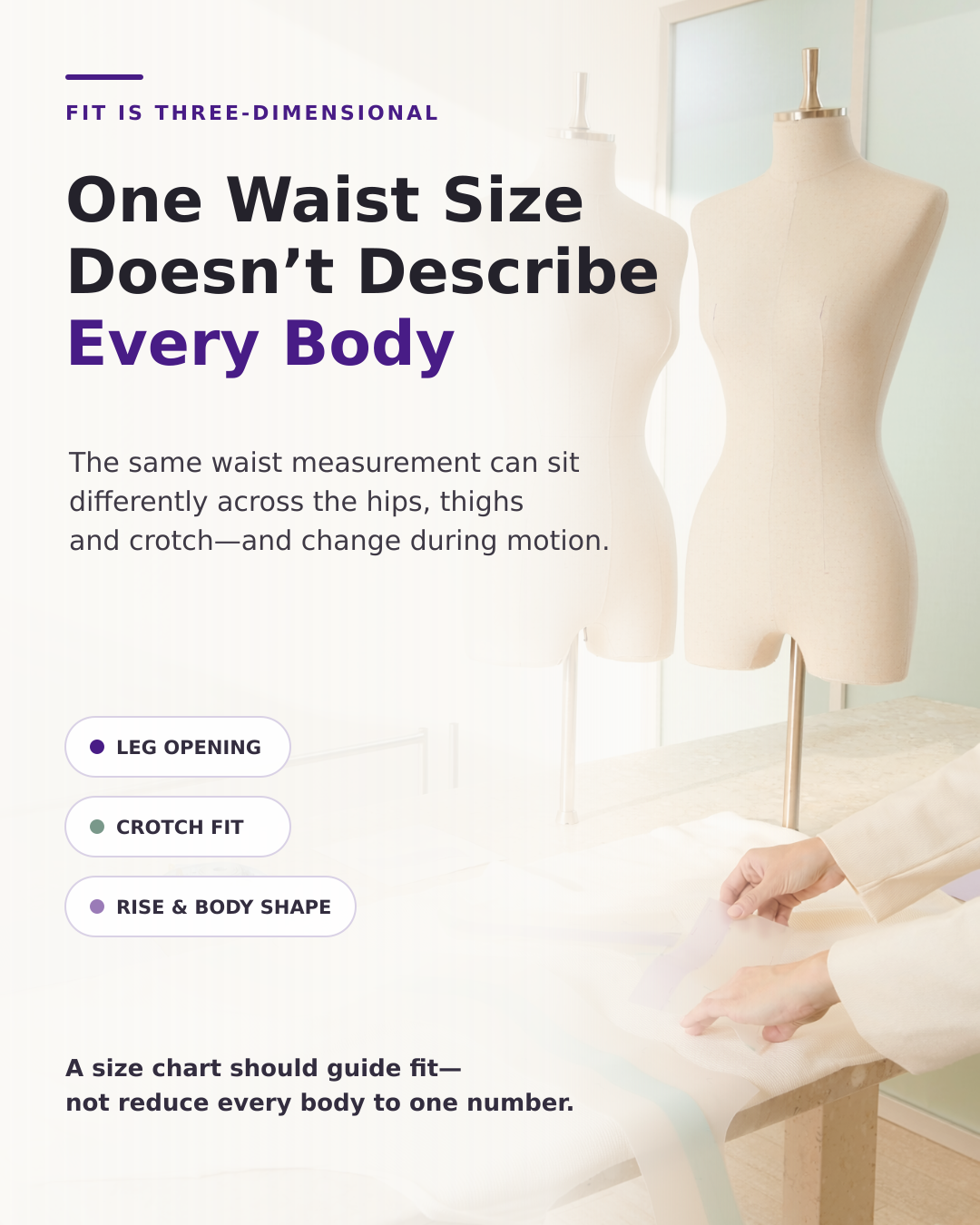
A waistband can feel correct while the rest of the garment does not. Two people with a similar waist measurement may have different hip shapes, thigh proportions and rise requirements. The same nominal size can therefore create different results at the leg openings and crotch.
In practical use, several fit failures can look like an absorbency problem:
- a gap at the leg opening that allows a sudden leak to escape before it reaches the core;
- a loose or low-hanging crotch that reduces contact with the intended acquisition zone;
- a product that fits when dry but sags after absorbing liquid;
- excess bulk that becomes visible under clothing or restricts comfortable movement;
- elastic tension that feels secure at first but becomes uncomfortable during extended wear.
Current fitting guidance already reflects some of this complexity. For example, TENA’s washable incontinence-pants guide asks users to measure both hips and waist and recommends a snug fit for leakage security. Continence Product Advisor similarly explains that close-fitting, elasticated pull-on pants are intended to keep the absorbent section in position.
For product teams, this points beyond a single “S–XL” table. Hip measurement, garment rise, leg-opening tension, core width and movement testing can all influence whether the listed size works across different body shapes.
The category is dividing by use context
“Adult incontinence product” now covers very different daily realities. One person may need high-capacity protection and caregiver-friendly changing. Another may experience light stress leaks when coughing, lifting, running or travelling, and may change the product independently.
The NHS notes that thin, discreet pads and pull-up pants are available for mild to moderate incontinence, while products intended for more severe leakage tend to be larger and bulkier. This is not a simple better-versus-worse comparison. It is a reminder that protection should be matched to the leak level, mobility and setting.
The trade-off is visible in product testing too. In one independent comparison, a high-absorbency disposable option performed strongly in liquid testing but was also described by wear testers as noticeable under clothing and less suitable beneath workout leggings. Maximum capacity solved one problem while creating a different wear concern.
This supports a more useful division of the category:
- high-absorbency, care-oriented protection for heavier leakage, longer wear periods or assisted changing; and
- lighter, discreet, activity-oriented protection for independent users managing light bladder leaks during everyday movement.
The boundary should remain clear. “Thin” or “seamless” does not mean suitable for every level of incontinence, just as “maximum absorbency” does not automatically mean ideal for every body or activity.
Why period underwear enters the conversation
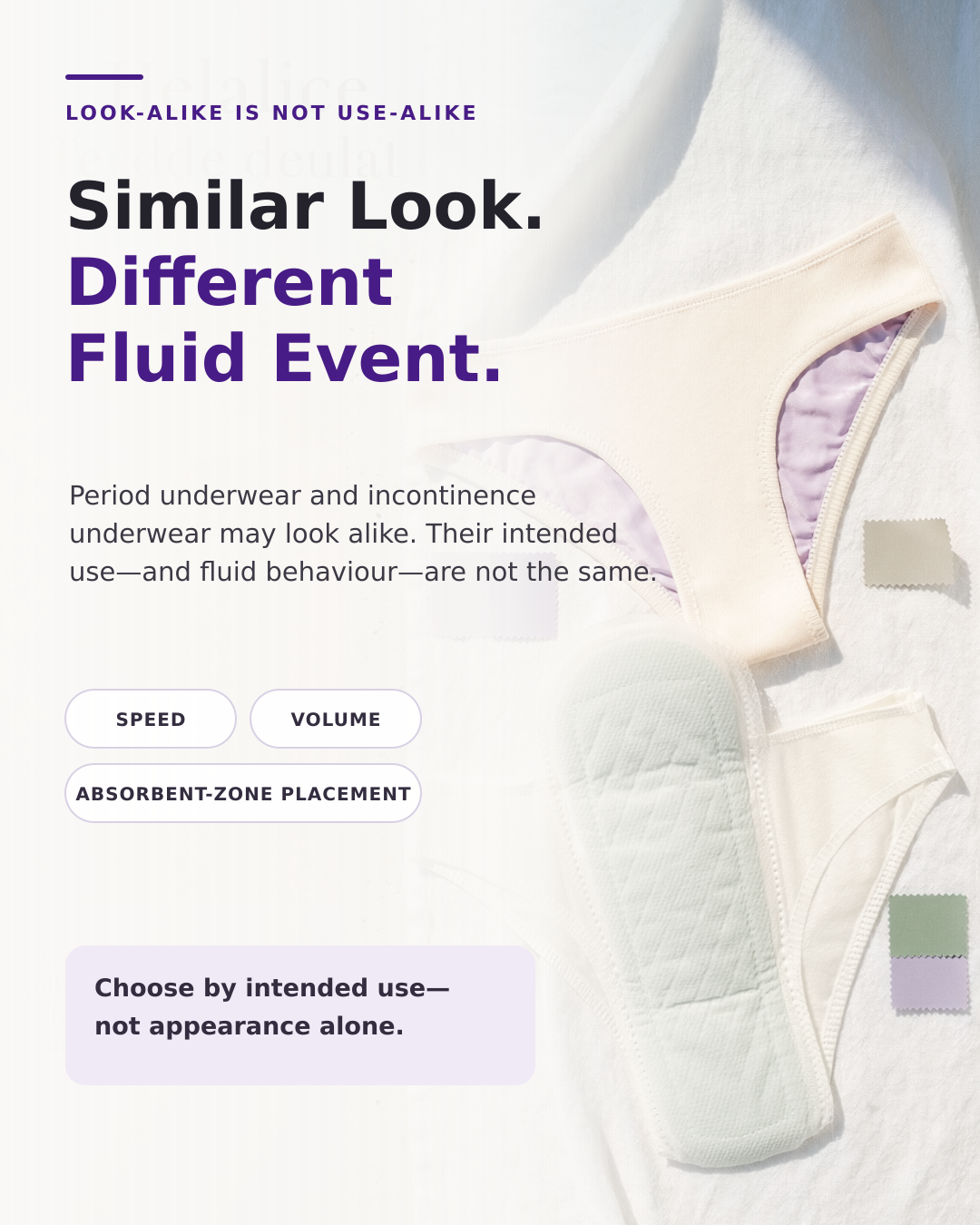
Period underwear and reusable incontinence underwear can look very similar from the outside. Both may use soft fabrics, familiar underwear silhouettes and discreet built-in absorbent zones. For someone trying to avoid a medical appearance, period underwear may therefore feel like the more familiar choice.
But visual similarity does not prove equivalent performance. Menstrual flow and bladder leaks differ in consistency, volume pattern and speed of release. The product must acquire the fluid quickly enough, direct it to the right part of the absorbent zone and retain it under pressure and movement.
Cleveland Clinic notes that period underwear is intended for menstruation and advises people seeking protection specifically for urinary leakage to focus on a product designed for that purpose. TENA likewise cautions that most period pants are not engineered in the same way as washable incontinence underwear. Some products are explicitly tested and marketed for multiple fluids, but that capability should be confirmed rather than assumed from appearance alone.
Consumers crossing category lines should not be dismissed as confused. Their behaviour is a signal: many want bladder-leak protection that feels closer to ordinary underwear. The opportunity is not to blur the product categories, but to bring dignity, discretion and better design into products whose fluid-management claims remain clear.
What better guidance and product briefs could include
The consumer satisfaction gap is not solved by adding another superlative to the pack. Clearer product development begins with a more specific description of the wearer and the situation:
- What type and approximate volume of leakage is the product intended to manage?
- Is the wearer mainly sitting, sleeping, walking, exercising or travelling?
- Where should the acquisition and absorbent zones sit during those activities?
- How does the garment behave after liquid is absorbed?
- Do the waist, hip, rise and leg-opening relationships work across intended body shapes?
- Can the sizing guide explain fit without relying only on body weight or a single circumference?
- Does the product name and packaging support independence without implying that every user is elderly or dependent?
Laboratory capacity still matters. So do acquisition speed, rewet, retention and leakage control. But for underwear worn through a normal day, those measures need to connect with garment construction and movement.
The larger lesson
Adult incontinence protection is not one uniform need, and its users are not one uniform group. An active person with occasional stress leaks, a long-distance traveller and someone receiving daily care may all enter the same retail category while requiring very different products.
The strongest product is therefore not simply the thinnest or the most absorbent. It is the one whose capacity, fit, absorbent-zone placement and guidance match the conditions in which it will actually be worn.
Fit is not a cosmetic detail added after absorbency. In use, fit is part of performance.
Editorial note: This article discusses consumer-product design and selection signals. It does not provide medical diagnosis or treatment advice. Persistent or concerning urinary leakage should be discussed with an appropriate healthcare professional.
Sources:
The LYCRA Company — The Fit Satisfaction Gap: What Consumer Data Reveals
NHS — Products to help with urinary incontinence
Continence Product Advisor — Absorbent products for light bladder leakage in women
Cleveland Clinic — What Is Period Underwear and Does It Work?
TENA UK — Can Period Pants Be Used for Incontinence?
TENA UK — How to Find the Right Size of Washable Incontinence Pants
Reviewed — The Best Incontinence Underwear for Women