
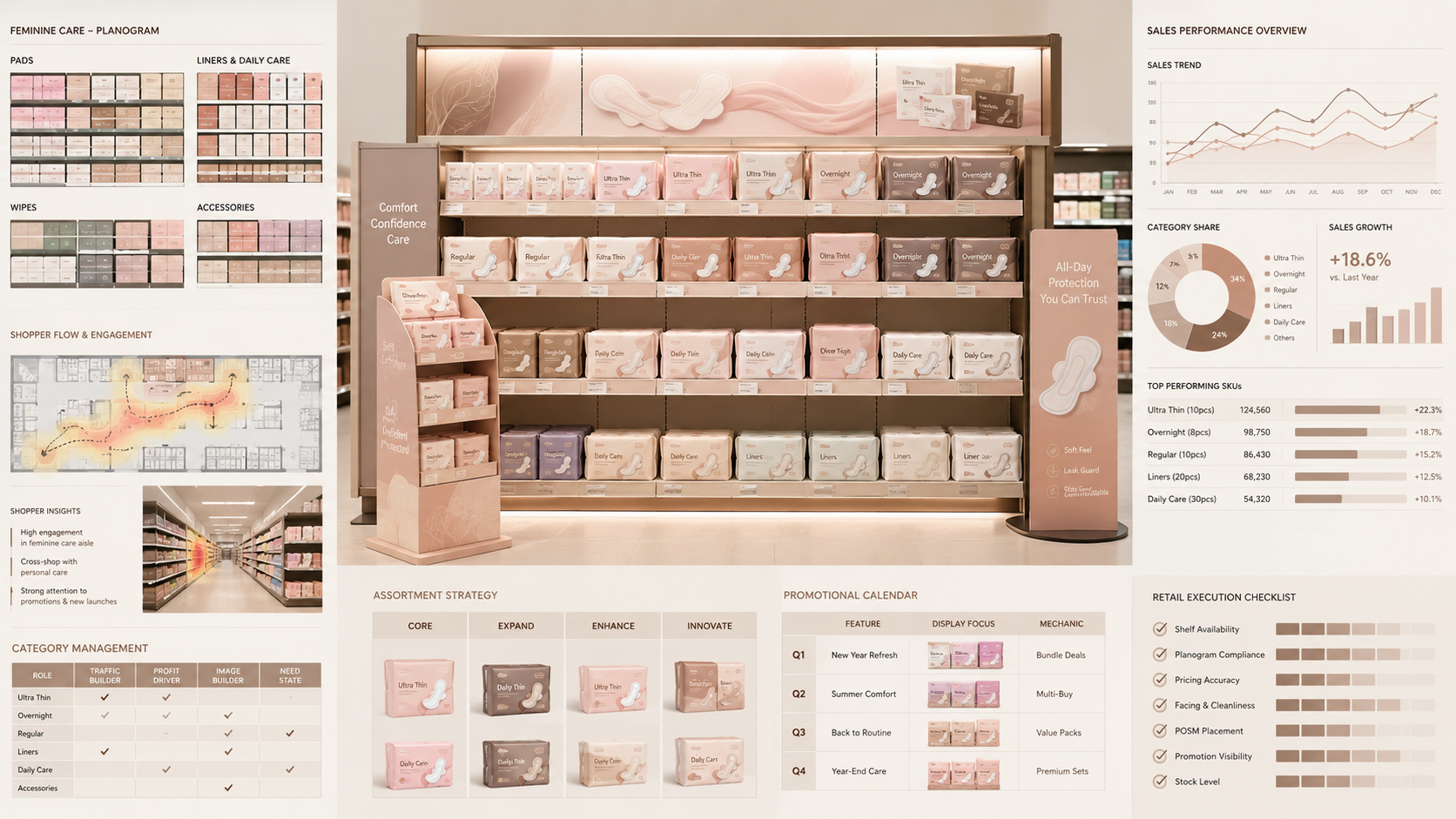
Retail & Channel Strategy
Sanitary Pad Retail Merchandising Guide: Shelf Placement, Assortment Strategy, and In-Store Visibility
Retail success is not determined solely by product quality. In many stores, product visibility, shelf placement, assortment structure, and merchandising execution directly influence consumer purchasing decisions. Strong merchandising turns shelf space into sales performance.
Merchandising Snapshot
Consumers rarely evaluate every sanitary pad available on a shelf. Most decisions are made within seconds. Effective merchandising helps products become easier to find, easier to compare, and easier to purchase.
Many brands spend significant resources developing products but give far less attention to shelf execution. Unfortunately, shoppers cannot purchase products they do not notice. Retail shelves are crowded, attention spans are short, and competitors are also attempting to win visibility.
A structured merchandising strategy helps sanitary pad brands improve category performance while supporting retailers, distributors, and consumers simultaneously.
1. Why Merchandising Matters in Feminine Care
Retail merchandising influences how consumers navigate the feminine hygiene category and make purchasing decisions.
- Improves product visibility
- Supports faster product selection
- Increases shopper confidence
- Encourages repeat purchases
- Improves category organization
- Supports promotional effectiveness
- Increases overall sales performance
Factory Insight
Retailers often prefer suppliers who actively support category management and merchandising because improved shelf organization frequently benefits the entire category, not just one brand.
2. Understanding Shopper Behavior
Consumers typically follow predictable shopping patterns when purchasing sanitary pads.
| Shopper Behavior | Impact on Merchandising | Recommended Action |
|---|---|---|
| Fast Decisions | Limited evaluation time | Simplify shelf navigation |
| Brand Familiarity | Repeat purchase behavior | Maintain visibility |
| Feature Comparison | Benefit evaluation | Clear packaging hierarchy |
| Convenience Seeking | Efficient shopping | Logical assortment organization |
3. Shelf Placement Fundamentals
Shelf position strongly affects product visibility and sales performance.
High-Visibility Shelf Zones
- Eye-level shelf positions
- Center-category placements
- High-traffic aisle sections
- Promotional endcap displays
- Secondary display locations
- Checkout-adjacent promotional zones
Products placed within natural shopper sightlines generally receive greater attention than products positioned at the lowest or highest shelf levels.
4. Assortment Strategy by Product Role
A balanced assortment helps consumers find products that match their needs without overwhelming category navigation.
| SKU Type | Merchandising Role | Shelf Priority |
|---|---|---|
| Core Day Pads | Volume driver | High |
| Night Pads | Category essential | High |
| Pantyliners | Cross-category support | Medium |
| Premium Products | Margin enhancement | Strategic visibility |
Buyer Tip
The goal of assortment planning is not maximizing SKU count. The goal is helping shoppers find the right product quickly while maintaining strong inventory turnover.
5. Creating an Effective Planogram
A planogram defines how products are arranged on shelves to maximize visibility, consistency, and category performance.
Planogram Development Checklist
- Group products by category.
- Position core SKUs centrally.
- Separate day and night products clearly.
- Maintain logical size progression.
- Highlight premium offerings.
- Ensure consistent facings.
- Review stock replenishment requirements.
- Test shopper navigation efficiency.
Consistency across stores improves shopper familiarity and strengthens brand recognition.
6. Packaging Visibility and Shelf Impact
Packaging serves as a silent salesperson in the retail environment.
| Packaging Element | Retail Function | Shopper Benefit |
|---|---|---|
| Color Coding | SKU identification | Faster selection |
| Size Indicators | Product comparison | Purchase confidence |
| Benefit Communication | Feature explanation | Decision support |
| Brand Consistency | Recognition | Trust building |
7. Promotional Display Opportunities
Secondary displays can significantly improve category visibility and trial purchases.
Factory Insight
Temporary promotional displays often generate strong results when aligned with seasonal campaigns, new product launches, or retailer marketing programs.
- Endcap displays
- Seasonal promotions
- New product launch units
- Cross-category displays
- Retail event merchandising
- Multi-buy promotional programs
8. Managing Shelf Facings
Shelf facings refer to the number of product units visible to shoppers from the front of the shelf.
Facing Allocation Principles
- Allocate more facings to top sellers.
- Maintain visibility for strategic SKUs.
- Adjust based on sales performance.
- Prevent frequent out-of-stock situations.
- Review category productivity regularly.
Higher-performing SKUs typically deserve greater shelf representation due to their contribution to category turnover.
9. Measuring Merchandising Success
Merchandising effectiveness should be evaluated through measurable performance indicators.
| Metric | What It Measures | Goal |
|---|---|---|
| Sales Growth | Category performance | Revenue improvement |
| Shelf Availability | Stock presence | Reduced stockouts |
| Inventory Turnover | Product movement | Efficiency |
| SKU Productivity | Shelf contribution | Optimization |
10. Common Merchandising Mistakes
Overcomplicated Assortments
Too many similar products can confuse shoppers and reduce category productivity.
Poor Shelf Organization
Disorganized shelves increase decision difficulty and reduce shopping efficiency.
Ignoring Shopper Navigation
Merchandising should support how consumers actually browse the category.
Underutilizing Secondary Displays
Promotional visibility opportunities are often missed despite strong sales potential.
11. Retail Merchandising Execution Roadmap
Recommended Implementation Process
| Step 1 | Analyze shopper behavior and category performance. |
| Step 2 | Develop optimized assortments. |
| Step 3 | Create standardized planograms. |
| Step 4 | Improve shelf visibility and facings. |
| Step 5 | Implement promotional displays. |
| Step 6 | Measure results and optimize continuously. |
Final Takeaway
Effective sanitary pad merchandising combines shopper psychology, assortment strategy, shelf placement, packaging visibility, and category management. The objective is creating a retail environment that helps consumers find products quickly and confidently.
Brands that invest in merchandising execution often improve visibility, retailer relationships, inventory productivity, and sales performance without necessarily expanding their product portfolios. Sometimes the smartest growth strategy is simply helping shoppers notice what is already on the shelf.
Retail Merchandising Summary Checklist
- Understand shopper behavior patterns.
- Optimize shelf placement.
- Develop balanced assortments.
- Create effective planograms.
- Strengthen packaging visibility.
- Use promotional displays strategically.
- Allocate facings based on performance.
- Track merchandising KPIs.
- Reduce category complexity where possible.
- Continuously improve shelf execution.