
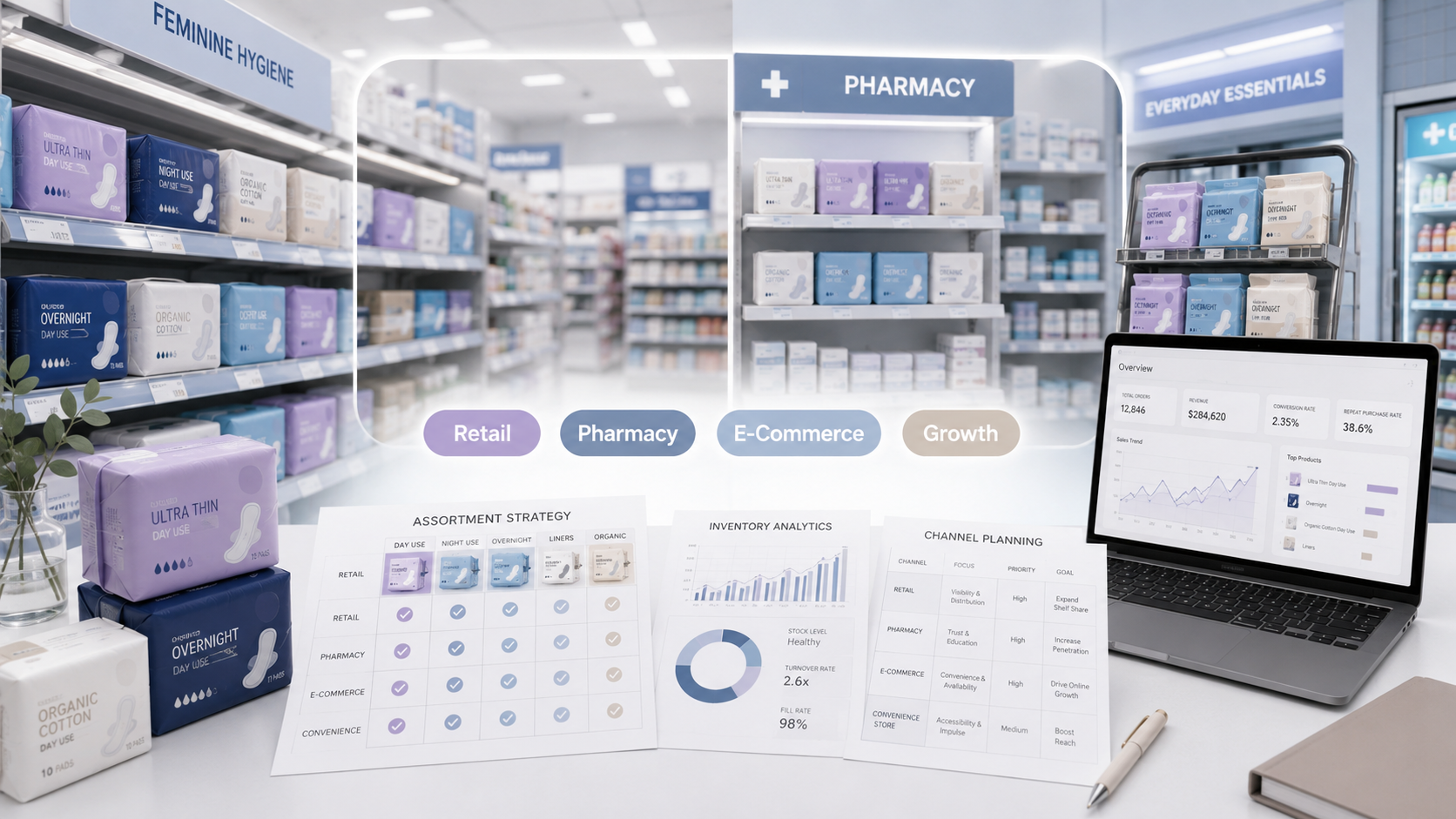
Retail & Channel Strategy
Sanitary Pad Retail Channel Strategy: Supermarkets, Pharmacies, Convenience Stores, and E-Commerce
Building a successful sanitary pad brand requires more than strong products. Growth depends on selecting the right retail channels, optimizing assortments for each environment, and creating a scalable strategy that aligns products, pricing, inventory, and consumer expectations.
Channel Strategy Snapshot
Different retail channels serve different shopper missions. Supermarkets emphasize variety and volume. Pharmacies focus on trust and health. Convenience stores prioritize speed and accessibility. E-commerce rewards assortment depth and consumer education.
Many sanitary pad brands attempt to sell identical products through every channel with identical pricing, packaging, and promotional strategies. Retail reality tends to reject such simplicity. Consumers behave differently depending on where they shop and why they entered the store in the first place.
A channel-specific strategy helps brands maximize sales while improving inventory turnover, retailer relationships, and long-term market penetration.
1. Why Retail Channel Strategy Matters
Retail channels influence product visibility, consumer perception, pricing expectations, and purchase frequency.
- Improves market coverage
- Supports portfolio optimization
- Increases retailer acceptance
- Improves inventory planning
- Enhances promotional effectiveness
- Supports sustainable growth
- Strengthens brand positioning
Factory Insight
Brands that understand channel dynamics often outperform competitors with larger product portfolios. Channel execution frequently creates more growth than adding additional SKUs.
2. Understanding the Four Major Retail Channels
| Channel | Primary Strength | Consumer Mission |
|---|---|---|
| Supermarkets | Volume sales | Routine shopping |
| Pharmacies | Trust and expertise | Health-focused purchases |
| Convenience Stores | Accessibility | Immediate needs |
| E-Commerce | Selection and information | Planned purchases |
3. Supermarket Channel Strategy
Supermarkets remain one of the largest sanitary pad sales channels in many markets. Consumers often purchase sanitary pads during routine household shopping trips.
Supermarket Success Factors
- Strong shelf visibility
- Competitive pricing
- Family-sized pack options
- Clear product differentiation
- Reliable inventory availability
- Promotional support programs
Supermarket assortments should focus heavily on core volume-driving SKUs with broad consumer appeal.
4. Pharmacy Channel Strategy
Pharmacies often attract consumers seeking trusted health and personal care products. Product credibility and comfort positioning become particularly important.
| Pharmacy Focus Area | Consumer Expectation | Brand Opportunity |
|---|---|---|
| Comfort | Reliable protection | Trust building |
| Performance | Product effectiveness | Premium positioning |
| Health-Oriented Claims | Product confidence | Category differentiation |
Buyer Tip
Pharmacy shoppers often spend more time evaluating product features. Packaging clarity and benefit communication become especially important in this channel.
5. Convenience Store Strategy
Convenience stores serve urgent purchase situations. Consumers frequently buy sanitary pads because they need them immediately rather than because they are planning a monthly stock-up trip.
Convenience Store Product Priorities
- Compact pack sizes
- Fast SKU recognition
- Essential product variants
- Strong shelf visibility
- Easy decision-making
- Consistent availability
In convenience channels, simplicity often wins. Excessive SKU complexity can reduce purchase speed and confuse shoppers.
6. E-Commerce Channel Strategy
E-commerce provides opportunities to offer broader assortments, educational content, subscription models, and direct consumer engagement.
| E-Commerce Advantage | Business Benefit | Growth Impact |
|---|---|---|
| Large Assortments | More product options | Higher basket size |
| Consumer Education | Better product understanding | Improved conversion |
| Subscriptions | Recurring purchases | Predictable revenue |
| Consumer Data | Market insights | Smarter decisions |
Factory Insight
E-commerce often becomes an effective testing ground for new sanitary pad products before broader retail expansion. Consumer feedback arrives faster, and assortment flexibility is much higher.
7. Channel-Specific Product Assortment Planning
Different channels require different SKU strategies.
| Channel | Recommended Assortment | Portfolio Focus |
|---|---|---|
| Supermarkets | Broad core range | Volume |
| Pharmacies | Premium and comfort-focused products | Trust |
| Convenience Stores | Fast-moving essentials | Accessibility |
| E-Commerce | Full portfolio | Choice and education |
8. Pricing Strategy by Channel
Pricing should support each channel's consumer expectations and operating economics.
Pricing Planning Checklist
- Understand retailer margin requirements.
- Evaluate competitor pricing.
- Maintain brand consistency.
- Avoid unnecessary channel conflicts.
- Support promotional activities.
- Protect long-term profitability.
9. Inventory Planning Across Channels
Channel demand patterns vary significantly. Inventory planning should reflect these differences.
| Channel | Inventory Characteristic | Planning Priority |
|---|---|---|
| Supermarkets | High volume | Availability |
| Pharmacies | Steady demand | Consistency |
| Convenience Stores | Fast replenishment | Speed |
| E-Commerce | Broader assortment | Forecast accuracy |
10. Common Retail Channel Mistakes
Using Identical Assortments Everywhere
Different channels serve different consumer missions and purchasing behaviors.
Ignoring Channel Economics
Retailers have different margin structures and operational expectations.
Weak Inventory Coordination
Poor forecasting can lead to stockouts or overstock across channels.
Underestimating E-Commerce Content
Online shoppers often require more information before purchasing than in-store shoppers.
11. Multi-Channel Growth Roadmap
Recommended Expansion Sequence
| Stage 1 | Launch core products through primary retail channels. |
| Stage 2 | Expand into pharmacies and specialized retailers. |
| Stage 3 | Strengthen e-commerce assortment and content strategy. |
| Stage 4 | Optimize channel-specific portfolios and promotions. |
| Stage 5 | Scale through coordinated multi-channel growth programs. |
Final Takeaway
Successful sanitary pad brands recognize that each retail channel serves different consumer needs and shopping behaviors. Supermarkets drive volume, pharmacies build trust, convenience stores deliver accessibility, and e-commerce provides education and assortment depth.
By developing channel-specific assortments, pricing structures, inventory plans, and growth strategies, private label brands can maximize retail performance while building a stronger and more resilient market presence.
Retail Channel Strategy Summary Checklist
- Define the role of each retail channel.
- Build channel-specific assortments.
- Align pricing with channel expectations.
- Support retailers with relevant promotions.
- Optimize inventory planning by channel.
- Strengthen e-commerce education and content.
- Monitor sales performance regularly.
- Avoid channel conflicts.
- Expand strategically rather than simultaneously.
- Use channel insights to improve portfolio decisions.