
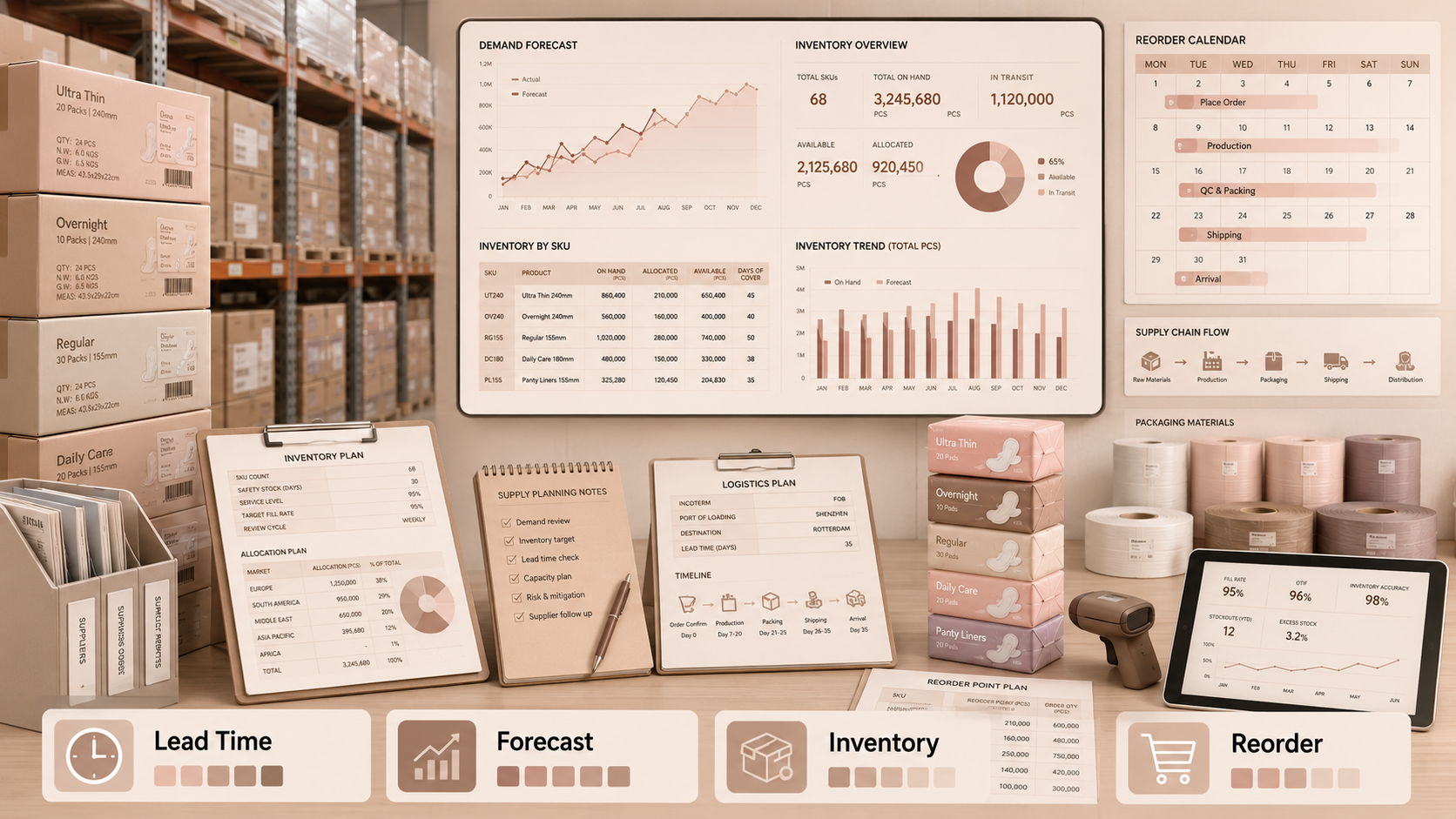
Distributor & Wholesale Guide
Sanitary Pad Mixed Container Orders: Combining SKUs, MOQ Optimization, and Freight Efficiency
Mixed container orders allow distributors and private label sanitary pad brands to combine multiple SKUs into a single shipment, improving MOQ flexibility, inventory balance, freight utilization, and market responsiveness.
For many distributors, ordering a full container of a single sanitary pad SKU rarely makes commercial sense. Different retailers require different pack sizes, absorbency levels, and product categories. A successful sanitary pad business usually depends on offering a balanced product portfolio rather than betting everything on one SKU and hoping reality cooperates.
Mixed container orders help solve this challenge. By combining multiple sanitary pad products within the same shipment, distributors can meet MOQ requirements, optimize freight costs, reduce inventory risk, and improve product availability across different sales channels.
Quick Buyer Note
The most efficient mixed container orders balance MOQ requirements, sales forecasts, carton dimensions, inventory turnover rates, and freight utilization. A container should support future sales, not simply fill empty shipping space.
1. What Is a Mixed Container Order?
A mixed container order combines several sanitary pad SKUs within one shipment. Instead of ordering only one product type, distributors can allocate container space across multiple products based on market demand.
Typical combinations include:
- Day pads + night pads
- Regular pads + premium pads
- Pantyliners + sanitary pads
- Economy packs + value packs
- Different lengths and absorbency levels
- Multiple private label product lines
Factory Insight
Many distributors initially focus on MOQ requirements. Experienced buyers focus on container utilization and inventory turnover because freight efficiency often impacts profitability more than minor unit-price differences.
2. Benefits of Mixed Container Orders
| Benefit | Business Impact | Distributor Advantage |
|---|---|---|
| Broader Product Range | More market coverage | Supports more retail channels |
| MOQ Flexibility | Reduces SKU risk | Simplifies first orders |
| Inventory Balance | Prevents overstock | Improves cash flow |
| Freight Optimization | Better container utilization | Lower landed cost |
3. Why MOQ Optimization Matters
MOQ optimization helps distributors reach production requirements without creating excessive inventory. Rather than over-purchasing one SKU, buyers can spread quantities across several products that match actual demand.
MOQ Optimization Goals
- Reduce inventory concentration risk
- Support broader market testing
- Improve cash flow allocation
- Increase product portfolio diversity
- Improve reorder flexibility
- Support distributor growth plans
The objective is not simply reaching MOQ. The objective is reaching MOQ intelligently.
4. Building an Effective SKU Mix
Successful mixed container planning starts with SKU selection. Product combinations should reflect actual market demand and distributor sales history.
| SKU Category | Role in Container | Typical Demand Pattern |
|---|---|---|
| Day Pads | Core volume driver | High turnover |
| Night Pads | Secondary volume | Stable demand |
| Pantyliners | Portfolio expansion | Variable demand |
| Premium Products | Margin enhancement | Market-dependent |
Buyer Tip
Start with your highest-turnover SKUs first. Use remaining container capacity for supporting products rather than allowing slower-moving products to dominate inventory.
5. Forecast-Based Container Allocation
Forecasting should guide SKU allocation. Product quantities should reflect expected sales rather than equal carton distribution.
Forecast Allocation Checklist
- Review sales history by SKU.
- Calculate average monthly demand.
- Estimate lead time requirements.
- Adjust for promotions and seasonality.
- Allocate container space accordingly.
- Review inventory turnover expectations.
- Validate warehouse capacity.
- Finalize carton distribution.
6. Freight Efficiency and Container Utilization
Container utilization significantly impacts landed cost. Poorly planned shipments may leave unused space or create inefficient carton configurations.
| Container Planning Factor | Goal | Impact |
|---|---|---|
| Carton Dimensions | Maximize space use | Lower freight cost |
| Weight Distribution | Improve loading stability | Reduce transport issues |
| SKU Mix | Balance inventory needs | Improve stock turnover |
| Volume Efficiency | Fill available capacity | Lower unit freight cost |
Factory Insight
A slightly higher product cost can sometimes result in a lower total landed cost if carton dimensions improve container utilization efficiency.
7. Inventory Balancing Across SKUs
Inventory balancing prevents some SKUs from selling out while others remain stagnant in the warehouse.
Distributors should evaluate:
- Monthly sales velocity
- Inventory turnover
- Retail channel demand
- Regional preferences
- Promotion schedules
- Lead time requirements
- Warehouse capacity
8. Mixed Container Orders for New Markets
When entering new markets, mixed container orders provide flexibility. Buyers can test multiple sanitary pad categories without committing excessive volume to any single product.
Market Entry Advantages
- Reduces launch risk
- Allows customer preference testing
- Improves product assortment
- Supports distributor feedback collection
- Provides sales data for future planning
9. Packaging and Carton Planning
Mixed container orders require careful carton planning. Different products may have different carton dimensions, pallet requirements, and warehouse handling considerations.
| Planning Area | Key Question | Reason |
|---|---|---|
| Carton Sizes | Do cartons stack efficiently? | Supports loading efficiency |
| SKU Labels | Can warehouse staff identify products easily? | Improves inventory accuracy |
| Pallet Planning | Will pallets remain stable? | Reduces handling risks |
10. Common Mixed Container Order Mistakes
Ignoring Sales Velocity
Equal SKU allocation rarely reflects actual market demand.
Focusing Only on MOQ
Meeting MOQ without considering inventory turnover can create overstock problems.
Poor Container Utilization
Unused shipping capacity increases effective freight cost per unit.
Overcomplicated SKU Selection
Too many slow-moving products can reduce inventory efficiency and increase management complexity.
11. Mixed Container Planning Workflow
Recommended Planning Roadmap
| Step 1 | Analyze sales and inventory performance. |
| Step 2 | Determine MOQ requirements by SKU. |
| Step 3 | Build a forecast-based SKU mix. |
| Step 4 | Optimize carton and pallet allocation. |
| Step 5 | Review freight utilization and landed cost. |
| Step 6 | Finalize shipment and monitor inventory performance. |
Final Takeaway
Mixed container orders give sanitary pad distributors greater flexibility, better inventory control, and stronger freight efficiency. By combining multiple SKUs strategically, businesses can improve market coverage while reducing inventory and logistics risks.
The most successful mixed container strategies are built around demand forecasting, MOQ optimization, inventory turnover, and container utilization. The goal is not merely filling a container. The goal is filling it with products customers will actually buy.
Mixed Container Order Summary Checklist
- Use sales forecasts to allocate SKU quantities.
- Balance MOQ requirements with inventory turnover.
- Optimize container space utilization.
- Monitor freight cost per unit.
- Include core high-volume products first.
- Use supporting SKUs to complete assortment needs.
- Review carton dimensions and pallet plans.
- Track inventory performance after arrival.
- Adjust future SKU mixes using actual sales data.
- Focus on long-term inventory efficiency, not only MOQ compliance.