
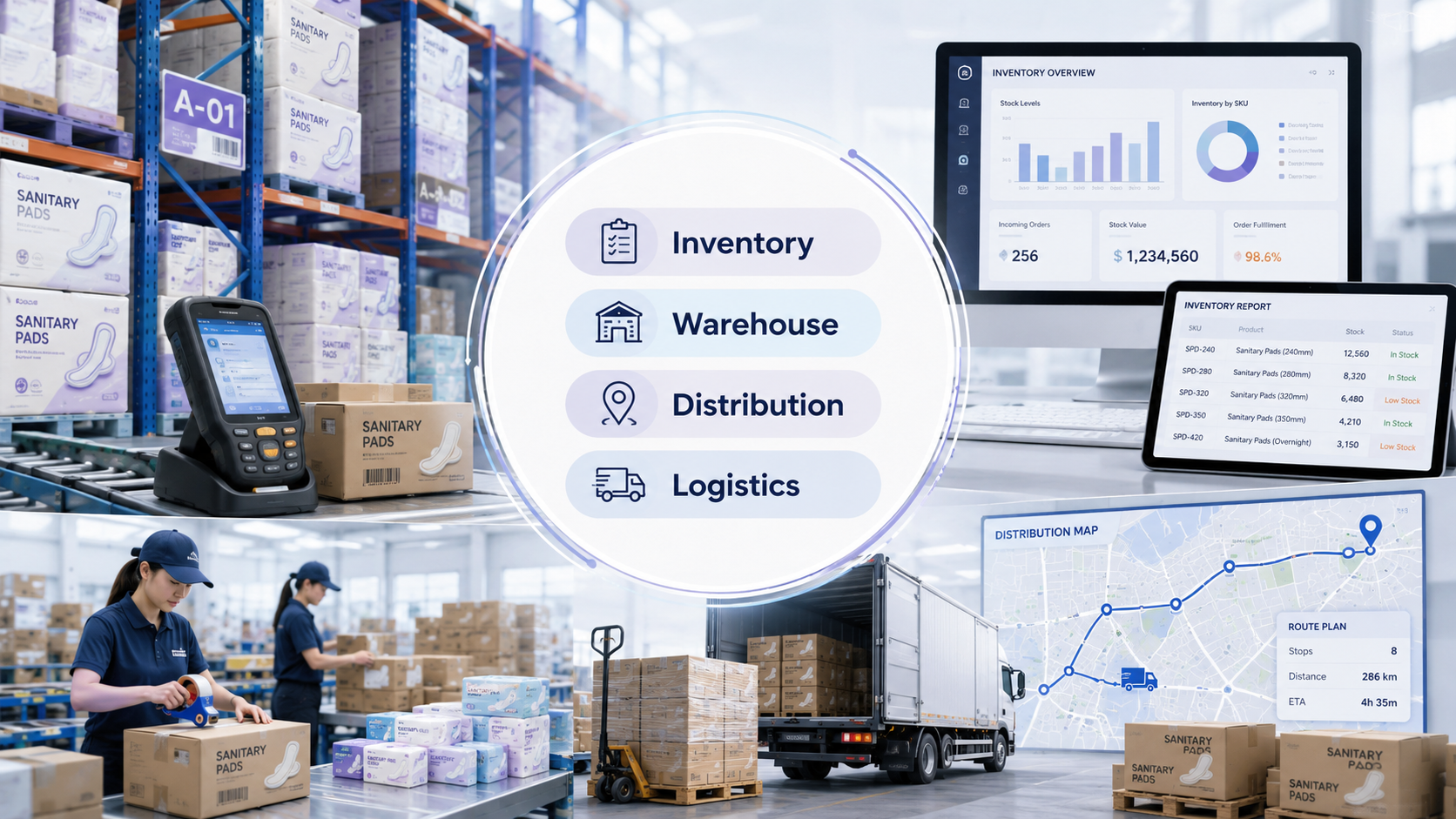
Supply Chain & Logistics
Private Label Sanitary Pad Warehouse & Distribution Guide: Inventory Management, Storage Standards, and Logistics Planning
Effective warehousing and distribution are essential for maintaining product availability, supporting retail partners, and scaling a sanitary pad business. A well-managed warehouse operation helps reduce costs, improve inventory accuracy, and strengthen overall supply chain performance.
Warehouse Management Is More Than Storage
Many growing brands view warehouses as simple storage facilities. In reality, warehouses function as operational hubs that influence inventory accuracy, order fulfillment speed, distributor satisfaction, and business scalability.
As sanitary pad brands expand across retail channels, distributors, and geographic regions, warehouse management becomes increasingly important. Poor inventory visibility can lead to stock shortages, delayed deliveries, excess inventory, and lost sales opportunities.
A structured warehouse and distribution strategy creates a stronger foundation for sustainable growth.
1. The Role of Warehousing in Sanitary Pad Supply Chains
Warehouses support multiple business functions throughout the supply chain.
- Inventory storage
- Order fulfillment
- Stock tracking
- Distribution coordination
- Quality preservation
- Retail replenishment
- Demand response management
Factory Insight
Inventory visibility often becomes more valuable than inventory volume. Businesses frequently struggle because they lack accurate inventory data rather than insufficient stock.
2. Understanding Inventory Categories
Different inventory categories require different management approaches.
| Inventory Type | Purpose | Management Priority |
|---|---|---|
| Available Stock | Customer fulfillment | High |
| Safety Stock | Supply protection | Critical |
| Reserved Inventory | Order allocation | Moderate |
| Transit Inventory | Distribution movement | High |
3. Storage Standards for Sanitary Pads
Proper storage conditions help preserve packaging quality and product integrity.
Storage Standards Checklist
- Clean storage environment
- Controlled humidity conditions
- Protection from contamination
- Organized pallet placement
- Clear inventory identification
- Regular housekeeping procedures
- Damage prevention controls
Storage standards should support both product quality preservation and operational efficiency.
4. Warehouse Layout Optimization
Warehouse design influences productivity, accuracy, and fulfillment speed.
| Warehouse Area | Function | Benefit |
|---|---|---|
| Receiving Zone | Inbound handling | Inventory accuracy |
| Storage Area | Inventory holding | Space utilization |
| Picking Area | Order preparation | Fulfillment speed |
| Shipping Zone | Outbound processing | Distribution efficiency |
Buyer Note
As product portfolios expand, warehouse organization becomes increasingly important. Clear location systems improve picking accuracy and reduce operational delays.
5. Inventory Tracking Systems
Accurate inventory tracking supports decision-making throughout the business.
Inventory Visibility Checklist
- Track stock movement.
- Monitor inventory levels.
- Review reorder triggers.
- Verify inventory accuracy.
- Monitor stock turnover.
- Maintain location records.
- Track shipment status.
Inventory visibility improves forecasting accuracy and supports more effective purchasing decisions.
6. Distribution Planning Fundamentals
Distribution planning ensures products reach customers and retail partners efficiently.
| Distribution Element | Primary Goal | Business Impact |
|---|---|---|
| Delivery Scheduling | Reliable service | Customer satisfaction |
| Route Planning | Efficiency | Cost control |
| Inventory Allocation | Availability | Sales support |
| Distributor Support | Market expansion | Growth acceleration |
7. Warehouse Performance Metrics
Measurement systems help identify operational improvement opportunities.
Factory Insight
Many supply chain problems become visible through warehouse performance metrics long before they affect customers or retailers.
- Inventory accuracy rate
- Order fulfillment speed
- Stock turnover ratio
- Picking accuracy
- Storage utilization
- Delivery performance
- Inventory availability
8. Managing Safety Stock Effectively
Safety stock provides protection against unexpected demand fluctuations and supply chain disruptions.
| Safety Stock Benefit | Operational Impact | Business Value |
|---|---|---|
| Stockout Prevention | Availability protection | Sales continuity |
| Supply Risk Reduction | Operational stability | Customer confidence |
| Forecast Protection | Demand flexibility | Service reliability |
9. Common Warehouse and Distribution Mistakes
Poor Inventory Visibility
Lack of accurate inventory data creates purchasing and fulfillment problems.
Overstocking Inventory
Excess stock increases storage costs and working capital requirements.
Weak Distribution Planning
Poor allocation decisions can create stock imbalances across regions.
Inconsistent Warehouse Processes
Operational inconsistencies often lead to fulfillment errors and delays.
10. Distribution Network Development
Network Development Checklist
- Define service regions.
- Evaluate distributor coverage.
- Review warehouse locations.
- Analyze transportation efficiency.
- Improve inventory positioning.
- Support retail replenishment.
- Monitor delivery performance.
11. Warehouse & Distribution Excellence Roadmap
Recommended Implementation Framework
| Phase 1 | Establish inventory visibility systems. |
| Phase 2 | Implement storage standards. |
| Phase 3 | Optimize warehouse layout. |
| Phase 4 | Develop distribution planning processes. |
| Phase 5 | Monitor performance metrics. |
| Phase 6 | Continuously improve logistics efficiency. |
Final Takeaway
Warehouse and distribution management are strategic capabilities that directly influence inventory availability, customer satisfaction, and business profitability. Effective operations require more than storage space. They require visibility, organization, planning, and continuous improvement.
Private label sanitary pad brands that invest in warehouse systems, inventory controls, distribution planning, and logistics optimization are better positioned to support growth while maintaining service reliability. Strong supply chains are rarely built by accident. They are built through disciplined operational management.