
Private Label Strategy
Private Label Sanitary Pad Product Line Planning: Core SKUs, Premium SKUs, and Market Segmentation
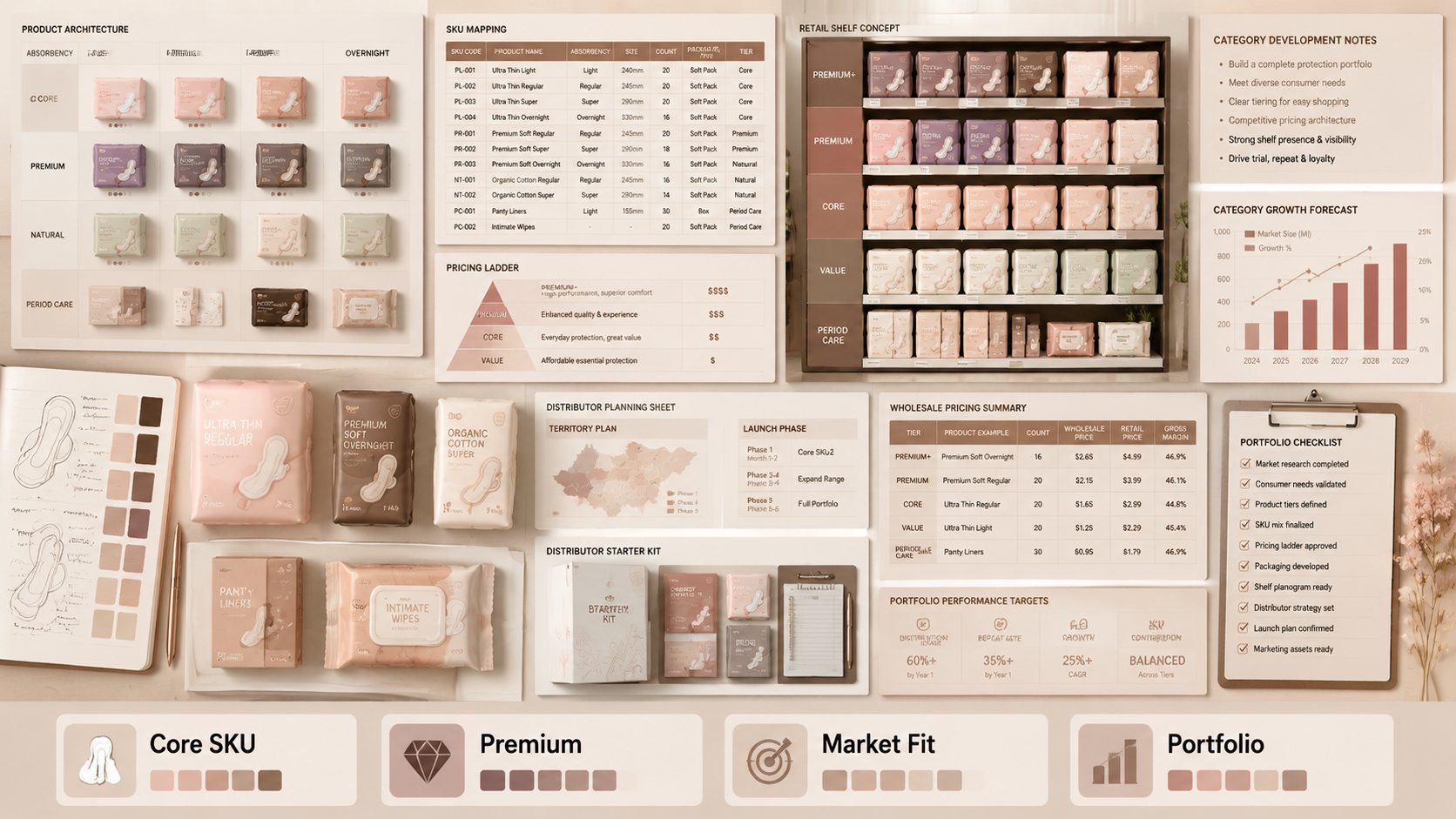
A successful sanitary pad brand is not built around a single product. Long-term growth depends on a structured product portfolio that balances core volume drivers, premium margin builders, distributor needs, and evolving consumer expectations.
Many new private label sanitary pad brands launch with one or two products and expect the market to organize itself around those choices. Markets generally refuse to cooperate. Consumers have different flow levels, budgets, preferences, lifestyles, and expectations. Product line planning exists because reality enjoys complexity.
A strong sanitary pad portfolio allows brands to serve multiple customer segments while maintaining operational efficiency, inventory control, and distributor confidence.
Quick Buyer Note
The best private label sanitary pad portfolios are usually built around a small number of high-volume core SKUs supported by carefully selected premium and specialty products.
1. Why Product Line Planning Matters
Product line planning helps brands avoid two common problems:
- Too few SKUs, limiting market coverage
- Too many SKUs, creating inventory complexity
A structured portfolio allows brands to:
- Reach more customer segments
- Increase retailer acceptance
- Improve distributor opportunities
- Support cross-selling
- Improve inventory planning
- Create clearer pricing architecture
- Strengthen long-term brand positioning
Factory Insight
Many private label brands fail because they launch too many products before validating demand. Portfolio expansion should follow market evidence, not packaging enthusiasm.
2. Understanding Product Portfolio Structure
Most successful sanitary pad brands organize products into three major portfolio layers.
| Portfolio Layer | Primary Purpose | Business Goal |
|---|---|---|
| Core Products | Drive volume | Market penetration |
| Premium Products | Build margin | Profit growth |
| Specialty Products | Serve niche needs | Portfolio differentiation |
3. Core SKU Planning
Core SKUs generate the majority of sales volume. These products should be simple, reliable, competitively priced, and widely accepted across multiple markets.
Typical Core SKU Categories
- Regular day pads
- Night pads
- Winged sanitary pads
- Standard absorbency products
- Mainstream value packs
- High-turnover retail SKUs
Core products should usually represent the largest share of inventory investment and distributor focus.
4. Premium SKU Development
Premium products provide higher margins and help brands establish stronger market positioning.
Premium sanitary pad features may include:
- Ultra-thin construction
- Enhanced absorbency systems
- Soft-touch top sheets
- Breathable materials
- Organic-inspired positioning
- Individual premium wrapping
- Enhanced packaging design
Buyer Tip
Premium products should offer meaningful consumer value. Premium packaging alone rarely creates sustainable premium positioning.
5. Specialty Product Opportunities
Specialty products serve specific consumer groups and can help differentiate a private label brand.
| Specialty Segment | Target Need | Positioning Goal |
|---|---|---|
| Pantyliners | Daily freshness | Routine usage expansion |
| Extra-Long Pads | Heavy flow support | Performance leadership |
| Travel Packs | Convenience | Lifestyle positioning |
| Sensitive-Skin Products | Comfort focus | Niche differentiation |
6. Market Segmentation Strategy
Not every customer buys sanitary pads for the same reasons. Product planning should reflect different purchasing motivations.
Key Market Segments
- Value-focused consumers
- Mainstream family buyers
- Premium-focused shoppers
- Comfort-oriented consumers
- Performance-driven users
- Convenience-focused buyers
- Young adult consumers
- Urban lifestyle segments
A balanced portfolio can serve multiple segments without overwhelming operational complexity.
7. Creating a Pricing Ladder
A pricing ladder helps consumers understand product differences while encouraging trade-up opportunities.
| Tier | Product Role | Business Objective |
|---|---|---|
| Entry Level | Volume acquisition | Expand customer base |
| Mid-Tier | Mainstream positioning | Generate stable sales |
| Premium | Higher-value offering | Improve profitability |
Factory Insight
A pricing ladder works best when product benefits become progressively stronger. Consumers should understand why a premium SKU costs more.
8. Distributor-Friendly Portfolio Planning
Distributors prefer product lines that are easy to understand, stock, and sell.
Distributor-friendly portfolios typically feature:
- Clear SKU differentiation
- Consistent packaging architecture
- Balanced inventory requirements
- Predictable reorder patterns
- Logical pricing structures
- Manageable MOQ levels
9. Inventory Implications of Product Expansion
Every additional SKU increases inventory complexity. Product expansion should be supported by measurable demand and operational readiness.
Before Adding a New SKU
- Validate customer demand.
- Review distributor interest.
- Estimate reorder frequency.
- Analyze packaging requirements.
- Evaluate warehouse impact.
- Calculate forecast inventory levels.
- Assess long-term profitability.
10. Portfolio Expansion Roadmap
Most successful sanitary pad brands grow their portfolios gradually rather than launching every category simultaneously.
| Growth Stage | Recommended Focus | Primary Objective |
|---|---|---|
| Launch Stage | Core day and night pads | Market entry |
| Growth Stage | Premium extensions | Margin improvement |
| Expansion Stage | Specialty categories | Market differentiation |
| Mature Stage | Portfolio optimization | Efficiency and profitability |
11. Common Product Line Planning Mistakes
Launching Too Many SKUs
Complex portfolios often create inventory and forecasting challenges before demand is proven.
Ignoring Market Segmentation
Not every consumer has identical needs or purchasing motivations.
Weak Pricing Architecture
Consumers should clearly understand product differences between tiers.
Expanding Before Core Success
Premium and specialty products work best after core products achieve stable demand.
12. Product Portfolio Planning Blueprint
Recommended Portfolio Structure
| Core Layer | Regular day pads, night pads, mainstream volume products. |
| Premium Layer | Enhanced comfort, performance, and packaging features. |
| Specialty Layer | Targeted solutions and niche consumer needs. |
| Future Layer | Innovation pipeline supported by market data and customer feedback. |
Final Takeaway
Private label sanitary pad success depends on building the right portfolio rather than the largest portfolio. Core products create sales volume, premium products improve profitability, and specialty products support differentiation.
By aligning SKU planning with market segmentation, distributor requirements, pricing strategy, and inventory management, brands can create scalable product lines that support sustainable growth and stronger retail performance.
Product Line Planning Summary Checklist
- Build around high-volume core SKUs first.
- Add premium products to strengthen margins.
- Use specialty products selectively.
- Create clear market segmentation.
- Develop a logical pricing ladder.
- Keep portfolios distributor-friendly.
- Validate demand before expansion.
- Monitor inventory complexity carefully.
- Use sales data to guide future development.
- Prioritize portfolio quality over SKU quantity.