
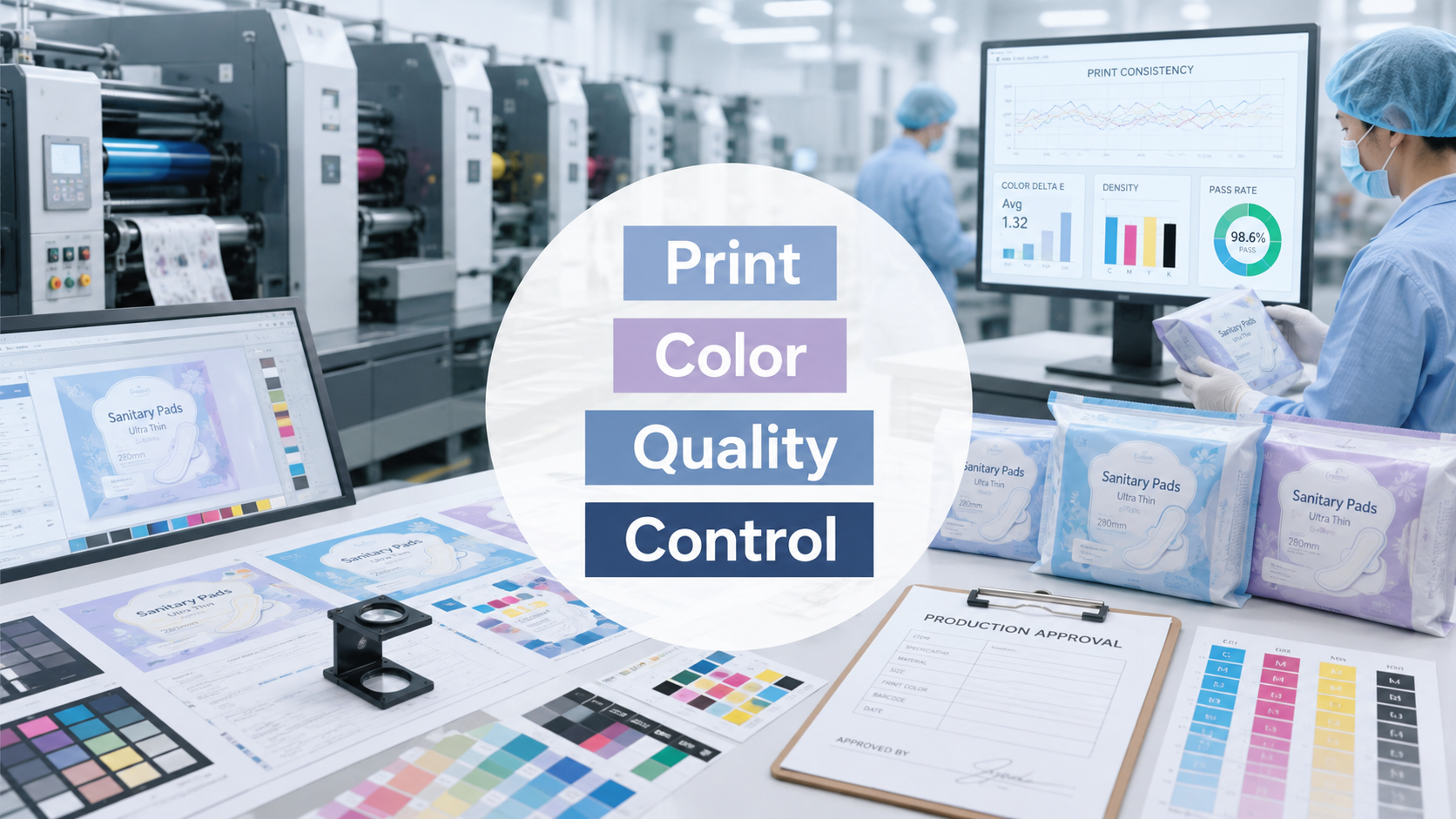
Manufacturing & Sourcing
Private Label Sanitary Pad Printing Guide: Packaging Printing Methods, Color Control, and Quality Standards
High-quality packaging printing plays a critical role in sanitary pad brand presentation. Consumers often evaluate packaging before they evaluate the product itself. Consistent printing quality helps build trust, strengthen shelf presence, and support long-term brand recognition.
Printing Matters More Than Many Brands Expect
Even exceptional packaging design can fail if print execution is inconsistent. Color shifts, blurred text, barcode problems, poor registration, and material incompatibility can negatively affect retail presentation and consumer perception.
Printing is the stage where digital artwork becomes a physical package. Every detail, from color accuracy to material compatibility, influences how the final product appears on store shelves and in consumers' hands.
A structured printing quality strategy helps private label sanitary pad brands maintain consistency across production runs and market regions.
1. Understanding Packaging Printing in Sanitary Pad Manufacturing
Packaging printing involves transferring approved artwork onto packaging materials while maintaining color accuracy, readability, and production consistency.
- Retail package printing
- Individual wrapper printing
- Master carton printing
- Shipping carton identification
- Barcode printing
- Promotional packaging production
- Private label branding execution
Factory Insight
Consumers often notice printing inconsistencies immediately, even when product quality remains unchanged. Packaging quality frequently influences perceived product quality.
2. Common Packaging Printing Methods
Different printing methods are used depending on packaging materials, production volumes, and design requirements.
| Printing Method | Primary Advantage | Typical Use |
|---|---|---|
| Flexographic Printing | Production efficiency | Flexible packaging |
| Gravure Printing | Image quality | High-volume production |
| Digital Printing | Flexibility | Short-run projects |
| Offset Printing | Sharp detail | Paperboard packaging |
3. Color Management Fundamentals
Color consistency is one of the most important elements of packaging quality control.
Color Control Priorities
- Brand color consistency
- Print-to-print stability
- Market-wide uniformity
- Packaging recognition
- Retail shelf impact
- Consumer trust reinforcement
Small color variations may appear insignificant during production but become highly visible when products from different batches are displayed together.
4. CMYK and Brand Color Systems
Most commercial packaging printing relies on standardized color systems to improve consistency.
| Color Element | Function | Control Objective |
|---|---|---|
| CMYK Values | Print production | Repeatability |
| Brand Standards | Visual identity | Consistency |
| Proof References | Approval baseline | Quality verification |
| Production Samples | Batch monitoring | Ongoing control |
Buyer Note
Brands should maintain documented color references rather than relying on screen previews. Monitors, printers, and materials can all display colors differently.
5. Packaging Material and Print Compatibility
Printing performance depends heavily on packaging material selection.
Different substrates absorb ink differently, affecting color vibrancy, sharpness, and durability.
Material Compatibility Checklist
- Confirm print surface suitability.
- Evaluate ink adhesion.
- Verify durability requirements.
- Review color reproduction capability.
- Assess transportation performance.
- Approve production samples.
6. Print Proofing and Pre-Production Verification
Print proofing provides an opportunity to evaluate packaging before large-scale production begins.
| Proofing Stage | Primary Review | Goal |
|---|---|---|
| Digital Proof | Layout accuracy | Error detection |
| Color Proof | Color validation | Brand consistency |
| Production Sample | Final evaluation | Approval readiness |
7. Packaging Print Quality Standards
Packaging should meet predefined quality standards before release.
Factory Insight
Print quality inspections are most effective when conducted throughout production rather than only after production is completed.
- Sharp text readability
- Consistent color reproduction
- Correct registration alignment
- Clean barcode printing
- Uniform image quality
- Material integrity preservation
- Stable production consistency
8. Common Printing Defects and Prevention
| Defect Type | Potential Cause | Prevention Focus |
|---|---|---|
| Color Shift | Calibration variation | Color monitoring |
| Blurred Graphics | Production instability | Equipment control |
| Misregistration | Alignment issues | Press calibration |
| Barcode Failure | Poor print quality | Verification testing |
9. Supplier Coordination for Print Consistency
Strong communication between brands, packaging suppliers, and printers improves production reliability.
Supplier Alignment Checklist
- Document approved artwork.
- Maintain color standards.
- Archive approved proofs.
- Define inspection criteria.
- Standardize approval procedures.
- Review production samples regularly.
10. Packaging Print Audit Framework
Artwork Verification
Ensure approved files match production files exactly.
Color Consistency Review
Compare production output against approved references.
Barcode Testing
Confirm reliable retail scanning performance.
Batch Documentation
Maintain records to support future consistency reviews.
11. Packaging Printing Excellence Roadmap
Recommended Print Management Process
| Step 1 | Approve final artwork files. |
| Step 2 | Verify material compatibility. |
| Step 3 | Review color proofs. |
| Step 4 | Approve production samples. |
| Step 5 | Monitor production quality. |
| Step 6 | Conduct final quality audits. |
Final Takeaway
Packaging printing is where brand strategy becomes a physical reality. Consistent printing quality supports retail performance, consumer trust, and long-term brand equity while helping products stand out in competitive markets.
Private label sanitary pad brands that invest in color management, proofing systems, supplier alignment, and print quality standards are better positioned to maintain packaging consistency across production runs and market expansions. In packaging production, consistency is not a cosmetic detail. It is a business asset.