
Manufacturing & Sourcing
Private Label Sanitary Pad Packaging Development Guide: Design Process, Material Selection, and Production Readiness
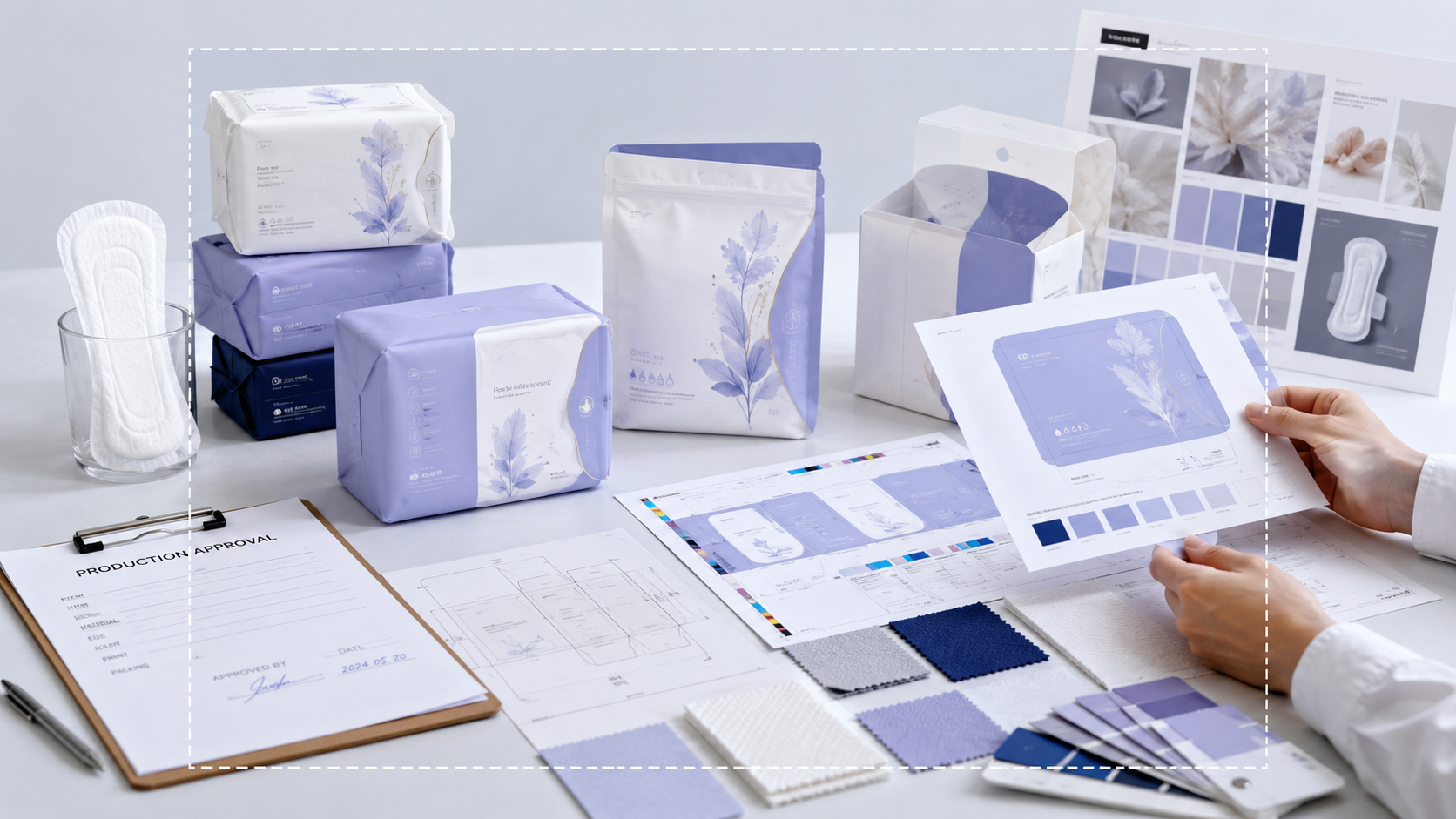
Packaging is often the first interaction consumers have with a sanitary pad brand. Effective packaging must balance product protection, brand communication, regulatory compliance, manufacturing practicality, and retail shelf appeal while supporting long-term business growth.
Packaging Development Overview
Successful packaging development involves far more than graphic design. It requires coordination between branding teams, packaging suppliers, printers, manufacturers, logistics partners, and regulatory stakeholders to ensure packaging performs effectively throughout the supply chain.
Many emerging sanitary pad brands focus heavily on product formulation while underestimating the importance of packaging development. In retail environments, packaging often determines whether consumers notice a product, understand its benefits, and ultimately decide to purchase it.
A structured packaging development process helps brands reduce costly revisions while accelerating production readiness.
1. Why Packaging Development Matters
Packaging serves multiple functions simultaneously throughout the product lifecycle.
- Protects product quality
- Communicates brand identity
- Supports retail visibility
- Provides product information
- Facilitates logistics handling
- Supports regulatory compliance
- Influences purchase decisions
Factory Insight
Packaging problems often create larger operational challenges than product issues because packaging affects production efficiency, warehousing, transportation, retail display, and consumer experience simultaneously.
2. Understanding Packaging Layers
Sanitary pad products typically involve several packaging levels.
| Packaging Layer | Purpose | Business Function |
|---|---|---|
| Individual Wrap | Product protection | Consumer convenience |
| Retail Package | Product presentation | Sales support |
| Inner Carton | Inventory organization | Warehouse efficiency |
| Master Carton | Transportation | Logistics protection |
3. Defining Packaging Objectives
Before beginning design work, brands should establish clear packaging objectives.
Packaging Strategy Checklist
- Target consumer profile
- Retail channel requirements
- Brand positioning goals
- Price segment alignment
- Product differentiation needs
- Logistics considerations
- Future portfolio expansion plans
Without defined objectives, packaging development often becomes a cycle of subjective design revisions and inconsistent decision-making.
4. Material Selection Considerations
Packaging materials influence appearance, durability, production efficiency, and cost structure.
| Material Factor | Importance | Evaluation Goal |
|---|---|---|
| Barrier Performance | Protection | Product integrity |
| Printability | Visual quality | Brand presentation |
| Durability | Supply chain protection | Damage prevention |
| Cost | Profitability | Margin support |
Buyer Note
Premium-looking materials do not automatically create premium products. Material selection should support brand positioning while remaining commercially sustainable.
5. Packaging Structure Development
Structural design influences usability, storage efficiency, and manufacturing compatibility.
The packaging format should accommodate product dimensions, retail display requirements, and logistics constraints without creating unnecessary complexity.
Structural Design Review
- Product fit verification.
- Opening convenience assessment.
- Shelf presentation review.
- Shipping durability evaluation.
- Production compatibility check.
- Storage efficiency analysis.
- Consumer usability testing.
6. Branding and Visual Design Development
Packaging design communicates product positioning within seconds.
| Design Element | Consumer Impact | Business Goal |
|---|---|---|
| Color System | Recognition | Brand consistency |
| Typography | Readability | Information clarity |
| Product Icons | Navigation support | Faster selection |
| Visual Hierarchy | Decision support | Improved conversion |
7. Compliance and Information Requirements
Packaging should include all required information before printing approval.
Factory Insight
Late-stage compliance revisions frequently create delays because packaging artwork may require reapproval, reprinting, or redesign before production can begin.
- Product identification
- Usage instructions
- Manufacturer information
- Lot coding requirements
- Barcode placement
- Regulatory labeling
- Language requirements
8. Print Preparation and Proofing
Printing accuracy directly affects packaging quality and brand presentation.
| Print Stage | Objective | Risk Reduction |
|---|---|---|
| Artwork Review | Design verification | Error prevention |
| Color Proofing | Color consistency | Brand accuracy |
| Sample Approval | Final confirmation | Production confidence |
9. Packaging and Production Readiness
Before production begins, packaging should be fully approved and production-ready.
Production Readiness Checklist
- Artwork approval completed.
- Material specifications confirmed.
- Print proofs approved.
- Barcode validation completed.
- Regulatory review finalized.
- Packaging supplier schedule confirmed.
- Production release authorized.
10. Common Packaging Development Mistakes
Designing Without Manufacturing Input
Some concepts appear attractive but create unnecessary production complexity.
Ignoring Logistics Requirements
Packaging must survive transportation and warehousing conditions.
Late Compliance Reviews
Regulatory corrections can delay production schedules significantly.
Excessive Packaging Complexity
Additional features increase cost, lead time, and operational risk.
11. Packaging Development Roadmap
Recommended Development Process
| Phase 1 | Define brand and packaging objectives. |
| Phase 2 | Select packaging structure and materials. |
| Phase 3 | Develop branding and visual design. |
| Phase 4 | Complete compliance reviews. |
| Phase 5 | Approve proofs and samples. |
| Phase 6 | Release packaging for production. |
Final Takeaway
Packaging development is a strategic business process that influences manufacturing efficiency, retail visibility, logistics performance, and consumer perception. Effective packaging supports both operational success and brand growth.
Brands that approach packaging development systematically can reduce delays, avoid unnecessary costs, strengthen product presentation, and improve launch readiness. In many cases, packaging becomes one of the most valuable investments a sanitary pad brand makes before reaching consumers.