Manufacturing & Sourcing
Private Label Sanitary Pad MOQ Guide: Minimum Order Quantities, Cost Structure, and Scaling Strategies
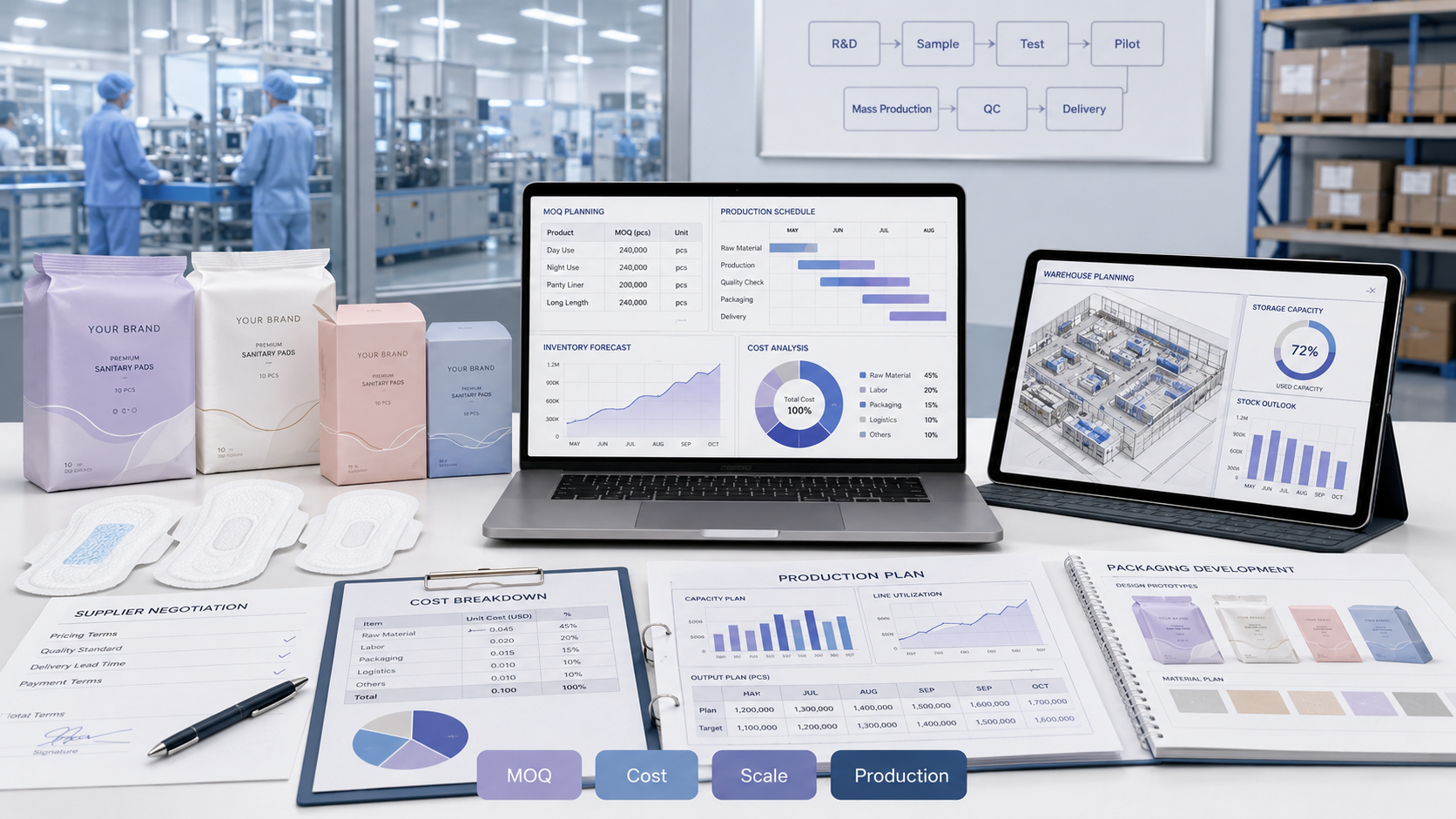
Minimum order quantities, commonly known as MOQs, are among the first realities new sanitary pad brands encounter when entering private label manufacturing. Understanding how MOQs work helps businesses make smarter sourcing decisions, manage risk, and build a scalable growth strategy.
MOQ Quick Overview
MOQs are not simply purchasing requirements. They are manufacturing efficiency tools that help factories optimize production schedules, material usage, labor allocation, packaging operations, and inventory management.
Many first-time buyers assume MOQ requirements are arbitrary numbers selected by factories. In reality, MOQ structures are typically linked to machinery setup costs, raw material purchasing requirements, packaging production runs, and manufacturing efficiency targets.
Understanding the business logic behind MOQs helps brands negotiate more effectively and scale more confidently.
1. What Is MOQ in Sanitary Pad Manufacturing?
MOQ refers to the minimum quantity a factory is willing to produce for a specific product, packaging configuration, or customization project.
- Product MOQ
- Packaging MOQ
- Printing MOQ
- Private label MOQ
- Custom material MOQ
- Carton MOQ
- Container MOQ
Factory Insight
A sanitary pad production line may require machine setup, material preparation, quality verification, and packaging calibration before production begins. These fixed activities create baseline production costs regardless of order size.
2. Why Factories Use MOQ Requirements
Factories use MOQs to maintain production efficiency and operational profitability.
| Reason | Manufacturing Impact | Business Benefit |
|---|---|---|
| Machine Setup | Fixed labor cost | Efficiency improvement |
| Material Purchasing | Supplier minimums | Cost control |
| Packaging Production | Printing requirements | Reduced waste |
| Production Scheduling | Line optimization | Higher productivity |
3. Common MOQ Categories
Not all MOQs apply to the same production element.
Typical MOQ Areas
- Product production quantity
- Custom packaging quantity
- Private label printing quantity
- Retail box quantity
- Master carton quantity
- Shipping container quantity
- Special material quantity
Brands should always clarify which MOQ applies to which component before approving production.
4. MOQ and Product Customization
Higher levels of customization often require higher minimum order quantities.
| Customization Level | MOQ Impact | Complexity |
|---|---|---|
| Standard Product | Lower | Basic |
| Private Label Packaging | Medium | Moderate |
| Custom Specifications | Higher | Advanced |
| Exclusive Development | Highest | Complex |
Buyer Note
New brands often reduce risk by launching with standard product specifications and customized packaging before investing in fully customized product development.
5. MOQ and Cost Structure
Order size directly affects unit cost.
As production volume increases, fixed manufacturing expenses are distributed across more units, reducing the average cost per piece.
| Cost Area | Low MOQ Impact | High MOQ Impact |
|---|---|---|
| Production Cost | Higher per unit | Lower per unit |
| Packaging Cost | Higher | Lower |
| Shipping Cost | Less efficient | More efficient |
| Inventory Cost | Lower | Higher |
6. Inventory Planning Around MOQ
MOQ decisions should align with realistic sales forecasts and inventory strategies.
Inventory Planning Checklist
- Estimate monthly sales volume.
- Determine inventory turnover targets.
- Calculate warehouse capacity.
- Review cash flow availability.
- Evaluate reorder lead times.
- Prepare safety stock levels.
- Monitor seasonal demand patterns.
Ordering more inventory than the market can absorb creates unnecessary storage and working capital pressure.
7. Negotiating MOQ with Manufacturers
MOQ requirements are not always completely fixed.
Factory Insight
Many factories may offer flexibility when buyers demonstrate long-term growth potential, simplified product specifications, or future volume commitments.
- Simplify packaging requirements
- Use existing materials
- Launch with standard formulations
- Commit to repeat orders
- Consolidate SKUs
- Discuss phased growth plans
8. MOQ Scaling Strategy for Growing Brands
Successful sanitary pad brands often scale gradually rather than pursuing maximum volume immediately.
| Growth Stage | Primary Goal | MOQ Approach |
|---|---|---|
| Launch | Market validation | Lower-risk quantities |
| Growth | Channel expansion | Moderate scaling |
| Established | Cost optimization | Larger production runs |
| Expansion | International growth | Strategic volume planning |
9. Common MOQ Mistakes
Ordering Beyond Market Demand
Lower production costs mean little if products remain in storage for extended periods.
Ignoring Cash Flow Impact
Large orders can create significant working capital pressure.
Excessive SKU Complexity
Multiple product variants can multiply MOQ requirements unexpectedly.
Focusing Only on Unit Cost
Inventory carrying costs should be evaluated alongside production savings.
10. MOQ Decision Framework
Before Approving Production
| Question 1 | Can projected sales support the order size? |
| Question 2 | Does available cash flow support inventory investment? |
| Question 3 | Is warehouse space sufficient? |
| Question 4 | Will larger volumes significantly improve costs? |
| Question 5 | Does the order align with growth objectives? |
11. Long-Term MOQ Optimization Strategy
As brands grow, MOQ management should evolve from risk reduction toward efficiency optimization.
Scaling Success Checklist
- Build accurate demand forecasts.
- Strengthen manufacturer relationships.
- Optimize SKU portfolios.
- Improve inventory turnover.
- Monitor cash flow performance.
- Review production costs regularly.
- Increase order efficiency gradually.
- Align MOQ decisions with business strategy.
Final Takeaway
MOQ requirements are a normal part of private label sanitary pad manufacturing. Rather than viewing them as obstacles, successful brands treat them as planning tools that support efficient production, better sourcing decisions, and long-term growth.
The most effective MOQ strategy balances production efficiency, inventory risk, cash flow management, and market demand. Brands that understand this balance are often better positioned to scale sustainably while maintaining healthy profitability.