
Manufacturing & Sourcing
Private Label Sanitary Pad Lead Time Guide: Production Scheduling, Shipping Timelines, and Inventory Planning
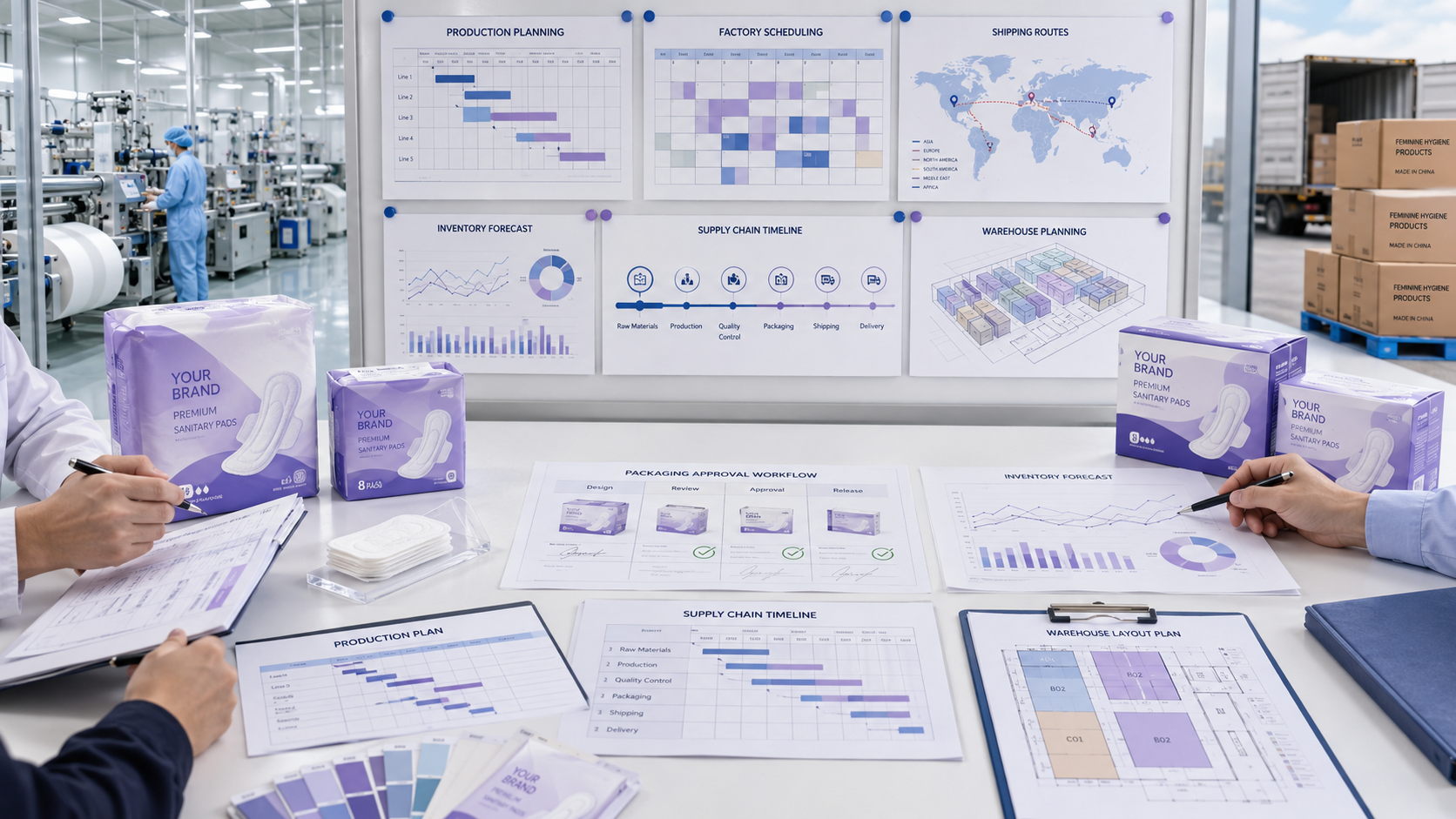
Lead time management is one of the most overlooked factors in private label sanitary pad operations. Understanding how production schedules, packaging preparation, quality inspections, and shipping timelines work together helps brands maintain inventory availability while supporting long-term growth.
Lead Time Overview
Lead time begins long before products enter production and continues until inventory becomes available for sale. Successful brands plan around the entire supply chain rather than focusing only on factory production days.
Many new sanitary pad brands assume lead time simply means manufacturing time. In reality, production often represents only one portion of the overall timeline. Packaging approvals, material procurement, scheduling queues, inspections, customs processing, and transportation all contribute to total lead time.
The brands that consistently maintain inventory availability are often the ones that manage lead times most effectively.
1. What Is Lead Time?
Lead time is the total duration between placing an order and receiving inventory ready for distribution or sale.
- Artwork approval time
- Material preparation time
- Production scheduling time
- Manufacturing time
- Quality inspection time
- Shipping time
- Warehouse receiving time
Factory Insight
Production capacity may fluctuate throughout the year. Peak seasons, major holidays, and promotional periods can extend scheduling queues even when actual manufacturing speed remains unchanged.
2. Understanding the Complete Lead Time Cycle
A private label sanitary pad order typically moves through several operational stages.
| Stage | Purpose | Risk Area |
|---|---|---|
| Artwork Approval | Packaging confirmation | Revision delays |
| Material Preparation | Component readiness | Supplier shortages |
| Production Scheduling | Line allocation | Capacity constraints |
| Manufacturing | Product production | Operational interruptions |
| Inspection | Quality verification | Correction requirements |
| Shipping | Inventory movement | Logistics disruptions |
3. Packaging Development and Approval Timelines
Packaging development frequently becomes one of the earliest sources of project delays.
Packaging Approval Checklist
- Artwork review
- Regulatory compliance checks
- Barcode verification
- Packaging specification approval
- Language review
- Final print confirmation
- Packaging sample sign-off
Delays often occur when multiple rounds of revisions are required after packaging production has already been scheduled.
4. Raw Material Procurement Lead Time
Sanitary pad manufacturing depends on multiple materials arriving on schedule.
| Material Category | Role | Planning Importance |
|---|---|---|
| Absorbent Materials | Core performance | Critical |
| Top Sheets | Comfort layer | High |
| Packaging Materials | Retail presentation | High |
| Cartons | Logistics support | Moderate |
Buyer Note
Custom materials and specialized packaging often require longer procurement timelines than standard production materials. Brands should account for this when planning launches.
5. Production Scheduling and Factory Capacity
Production scheduling determines when an order enters the manufacturing queue.
Even when production itself takes only a short period, queue times can extend overall lead times significantly during busy seasons.
Scheduling Considerations
- Current factory utilization.
- Seasonal demand cycles.
- Production line availability.
- Order complexity.
- Material readiness.
- Quality control scheduling.
- Packaging readiness.
6. Quality Inspection and Release Procedures
Quality verification should be included in lead time planning rather than treated as a separate event.
| Inspection Stage | Purpose | Benefit |
|---|---|---|
| Incoming Materials | Component verification | Consistency |
| Production Monitoring | Process control | Quality assurance |
| Final Inspection | Shipment approval | Risk reduction |
7. International Shipping Timelines
Shipping often represents a substantial portion of total lead time.
Factory Insight
Brands that only track production schedules often underestimate the impact of logistics delays. Effective supply chain planning includes transportation, customs processing, and warehouse receiving activities.
- Export preparation
- Port handling
- International transportation
- Customs clearance
- Domestic delivery
- Warehouse receiving
8. Lead Time and Inventory Planning
Inventory planning should be built around total lead time rather than manufacturing time alone.
| Planning Element | Purpose | Business Impact |
|---|---|---|
| Safety Stock | Buffer protection | Reduced stockouts |
| Forecast Accuracy | Demand planning | Inventory efficiency |
| Reorder Timing | Supply continuity | Operational stability |
| Seasonal Planning | Demand fluctuations | Improved availability |
9. Common Lead Time Risks
Late Artwork Approval
Packaging delays can postpone production scheduling and shipment readiness.
Material Shortages
Critical components may become unavailable if procurement planning is insufficient.
Production Congestion
Factory capacity constraints can extend scheduling timelines unexpectedly.
Logistics Delays
Transportation disruptions may affect delivery schedules and inventory availability.
10. Building a Reorder Timeline System
Recommended Reorder Framework
| Step 1 | Determine average monthly sales. |
| Step 2 | Calculate total lead time. |
| Step 3 | Establish safety stock levels. |
| Step 4 | Define reorder trigger points. |
| Step 5 | Monitor inventory weekly. |
| Step 6 | Adjust forecasts continuously. |
11. Scaling Lead Time Management as the Brand Grows
As order volumes increase, lead time planning becomes more important rather than less important.
Growth Management Checklist
- Forecast demand accurately.
- Maintain safety stock.
- Review supplier capacity regularly.
- Track production schedules proactively.
- Monitor shipping performance.
- Improve inventory visibility.
- Develop contingency plans.
- Align purchasing with growth forecasts.
Final Takeaway
Lead time management is a core component of successful private label sanitary pad operations. Production scheduling, packaging readiness, material availability, inspections, logistics, and inventory planning all contribute to supply chain performance.
Brands that understand and manage total lead time can improve inventory availability, reduce stockout risk, strengthen distributor relationships, and support sustainable business growth. In supply chain management, the most expensive inventory problem is often the inventory that never arrived when it was needed.