
Supply Chain & Logistics
Private Label Sanitary Pad Inventory Forecasting Guide: Demand Planning, Reorder Strategies, and Stock Optimization
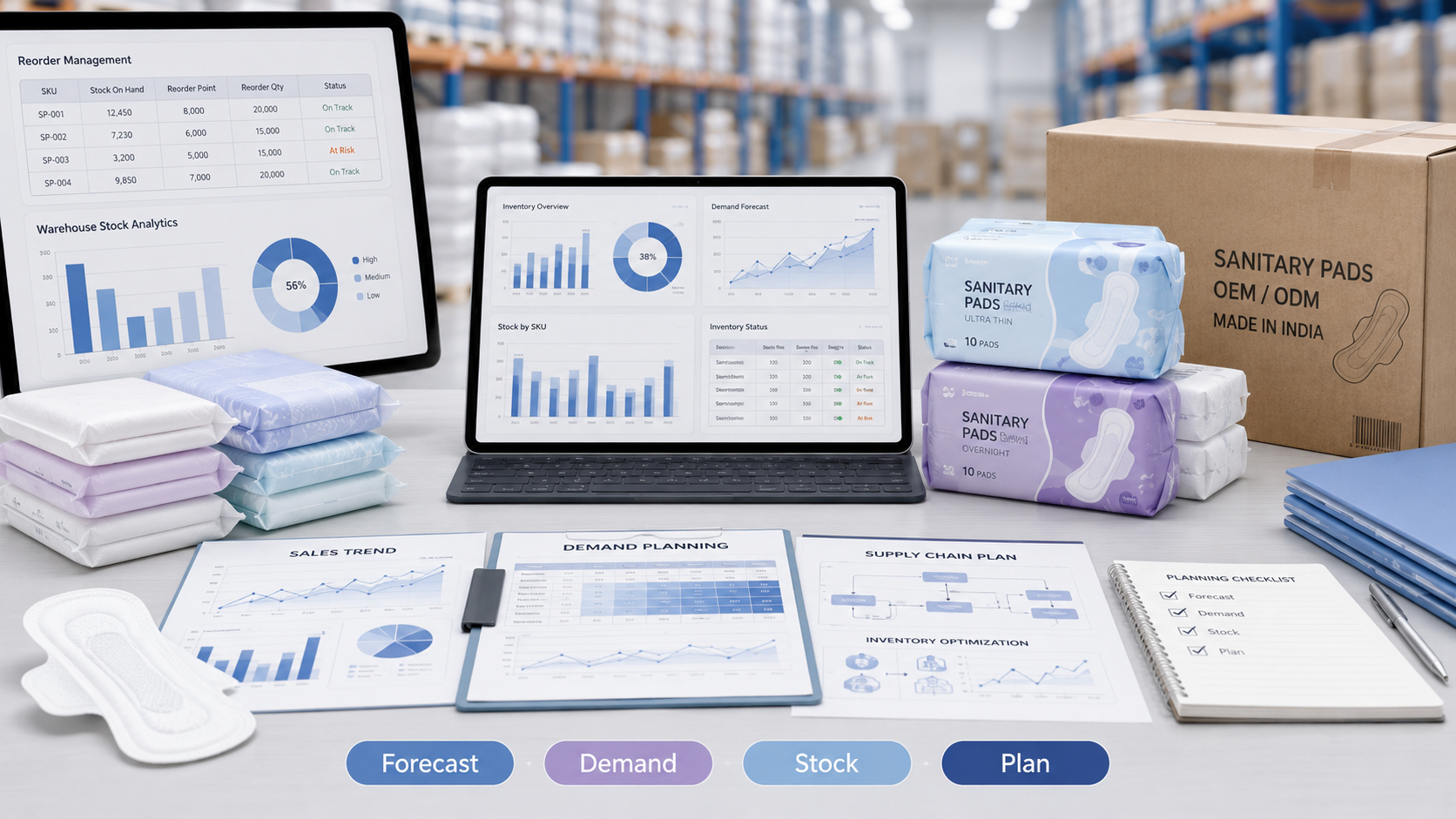
Inventory forecasting is one of the most important operational disciplines for sanitary pad brands. Effective forecasting helps maintain product availability, reduce excess inventory, improve cash flow, and support long-term business growth.
Why Forecasting Matters
Inventory shortages can damage retailer relationships and reduce sales opportunities, while excess inventory ties up capital and increases storage costs. Forecasting helps businesses find the balance between availability and efficiency.
Many growing sanitary pad brands focus heavily on production and marketing while underestimating inventory planning. However, demand forecasting often determines whether products remain available when consumers need them.
The most resilient brands build forecasting systems that combine sales history, market insights, inventory visibility, and supply chain planning.
1. What Is Inventory Forecasting?
Inventory forecasting is the process of estimating future product demand and planning stock levels accordingly.
- Sales prediction
- Inventory planning
- Purchase scheduling
- Production preparation
- Supply chain coordination
- Warehouse optimization
- Risk reduction
Factory Insight
Forecasting does not eliminate uncertainty. Its purpose is to improve decision quality by reducing guesswork and improving planning accuracy over time.
2. Core Components of Demand Planning
Demand planning combines multiple information sources to estimate future requirements.
| Forecasting Input | Purpose | Value |
|---|---|---|
| Historical Sales | Trend analysis | Baseline demand |
| Seasonal Patterns | Demand fluctuations | Planning accuracy |
| Promotional Activities | Sales impact estimation | Inventory preparation |
| Market Expansion | Growth planning | Capacity readiness |
3. Forecasting Challenges for Growing Brands
Forecasting becomes increasingly complex as brands scale across products and markets.
Common Forecasting Challenges
- Limited historical sales data
- Rapid market growth
- New product launches
- Promotional variability
- Distributor demand changes
- Regional market differences
- Supply chain disruptions
Forecasts should be reviewed regularly rather than treated as fixed predictions.
4. Understanding Inventory Turnover
Inventory turnover helps brands understand how efficiently stock is moving through the business.
| Turnover Indicator | Meaning | Business Impact |
|---|---|---|
| Fast Movement | Strong demand | Reorder focus |
| Balanced Movement | Healthy inventory | Operational stability |
| Slow Movement | Excess inventory | Capital utilization concerns |
Buyer Note
Inventory turnover should be evaluated alongside product strategy. Some products naturally move faster than others due to channel mix, promotions, and customer preferences.
5. Reorder Planning Fundamentals
Effective reorder planning helps maintain inventory availability without excessive stock accumulation.
Reorder Planning Checklist
- Monitor inventory levels.
- Track average demand.
- Review supplier lead times.
- Maintain safety stock.
- Evaluate sales trends.
- Adjust forecasts regularly.
- Coordinate purchasing schedules.
The most effective reorder systems account for both expected demand and unexpected fluctuations.
6. Safety Stock Strategy
Safety stock acts as a buffer against uncertainty.
| Risk Factor | Potential Effect | Safety Stock Benefit |
|---|---|---|
| Demand Spikes | Inventory shortages | Availability protection |
| Supply Delays | Stock interruptions | Operational continuity |
| Forecast Variance | Planning errors | Risk reduction |
| Market Expansion | Unexpected growth | Demand flexibility |
7. Forecasting by Product Portfolio
Not all sanitary pad products should be forecasted using the same assumptions.
Factory Insight
Brands often achieve better forecasting accuracy when they segment products based on demand patterns rather than managing every product category identically.
- Core bestselling products
- Premium product ranges
- Seasonal products
- Promotional bundles
- New product launches
- Regional variations
8. Inventory Optimization Principles
Inventory optimization balances availability and efficiency.
| Optimization Goal | Focus Area | Expected Outcome |
|---|---|---|
| Reduce Stockouts | Availability | Higher service levels |
| Lower Excess Stock | Efficiency | Better cash flow |
| Improve Planning | Forecasting | Operational stability |
| Increase Visibility | Inventory management | Faster decision-making |
9. Common Forecasting Mistakes
Relying Only on Historical Sales
Past performance provides useful insights but does not capture future market changes.
Ignoring Lead Times
Forecasts should align with supplier and production schedules.
Failing to Update Forecasts
Forecast accuracy declines when plans are not reviewed regularly.
Overreacting to Short-Term Changes
Temporary fluctuations should be analyzed carefully before major inventory decisions are made.
10. Building a Forecast Review Process
Forecast Review Checklist
- Review monthly sales trends.
- Compare forecast versus actual results.
- Adjust inventory assumptions.
- Evaluate market developments.
- Monitor retailer demand changes.
- Assess supplier performance.
- Update reorder plans.
11. Inventory Forecasting Excellence Roadmap
Recommended Planning Framework
| Phase 1 | Collect demand and inventory data. |
| Phase 2 | Build demand forecasts. |
| Phase 3 | Establish reorder policies. |
| Phase 4 | Implement safety stock controls. |
| Phase 5 | Review forecasting performance. |
| Phase 6 | Continuously optimize inventory strategy. |
Final Takeaway
Inventory forecasting is a strategic capability that helps sanitary pad brands maintain availability while improving operational efficiency. Accurate forecasting supports stronger purchasing decisions, more effective inventory management, and better customer service.
Private label sanitary pad brands that develop structured forecasting processes, safety stock strategies, and regular forecast reviews are often better equipped to navigate growth, market fluctuations, and supply chain uncertainty. Good forecasting cannot predict the future perfectly, but it can make the future far easier to manage.