
Industry Insights / INJEOLLY JOURNAL
Dry cleansing wipes are often introduced with familiar words such as soft tissue or cotton tissue. Those names can be convenient, but they may leave the buyer uncertain about what the product is made of and how it is intended to be used.
01Name the material accurately
A cloth with a cotton-like touch is not necessarily made of cotton. Request the composition and use a consumer description that matches it. EDANA’s manufacturing overview shows how different fibre mixes and processes produce different nonwoven structures. EDANA: nonwoven manufacturing and fibre mixtures The commercial name should help explain the product, rather than replace its material specification.
02Separate dry handling from wet use
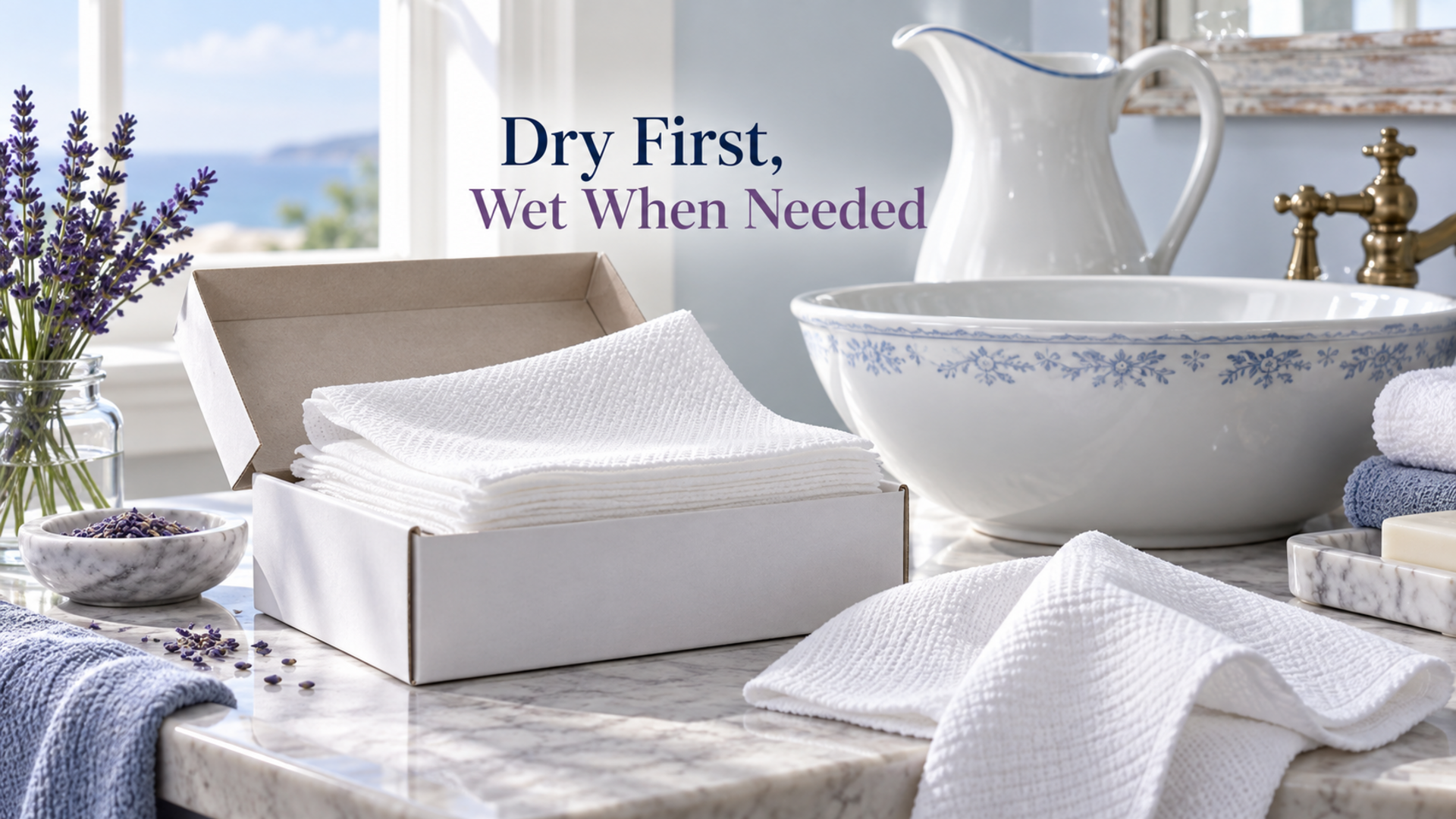
If the product is intended to be moistened before use, include that condition in the evaluation. Ask reviewers to describe how it unfolds and behaves under the defined wet-use task. A dry softness preference does not settle whether the cloth suits that task. Avoid declaring that one format replaces all facial tissues, towels or wet wipes; the intended use and supporting evidence should set the boundary.
Naming note
“Cotton tissue” should not conceal an unconfirmed fibre composition. Put the actual material identity into the specification.
03Give dimensions and dispensing equal attention
A sheet that works well once removed may still be awkward to access. Compare the actual folded format, the opening and the later stages of pack use. Record the sheet dimensions and pack count clearly so quotations refer to the same quantity of material. A larger box is not evidence of a larger sheet, and an attractive stack does not demonstrate easy single-sheet dispensing.
04Keep the promise proportionate
A straightforward product proposition can focus on the verified material, format and intended routine. Do not add sterile, antibacterial, hypoallergenic or flushable language merely because the product looks clean and white.
Those statements raise separate evidence questions. If the cloth is intended to be wetted when needed, the instructions should explain that use without suggesting an unvalidated practice of pre-wetting and storing a whole pack. The development goal is a clearly described product whose use is easy to understand and whose approved sample can be reproduced.
Define composition, intended wet or dry use, and dispensing before choosing the consumer-facing name.
Discuss your product briefProduct-development guidance. Evaluation methods and acceptance criteria should be defined for the exact product, intended use and destination market.