
Industry Insights / INJEOLLY JOURNAL
A demonstration that pours liquid onto a sanitary pad can be visually persuasive. It can also leave several important questions unanswered. How quickly did the liquid enter, where did it move, and what happened at the surface under the conditions of the test?
Separate the questions
Acquisition concerns liquid entering the product. Distribution concerns its movement through the structure. Rewet concerns liquid returning to the surface under a defined test procedure. SGS lists absorption speed, distribution and rewet among distinct areas of hygiene-product evaluation. Those distinctions are more useful than treating a single demonstration as a complete performance profile. SGS: absorbent hygiene product testing and evaluation
The procedure travels with the number
When reviewing results, ask which fluid, amount, delivery rate and waiting period were used, and whether pressure was applied. A result without its method is difficult to compare. A water demonstration should not silently become a claim about performance with menstrual fluid. Nor should results from different procedures be arranged in a ranking without checking whether the comparison is meaningful.
| Performance question | What to define |
|---|---|
| Acquisition | How does liquid enter under the stated procedure? |
| Distribution | Where does liquid move within the structure? |
| Rewet | What returns to the surface under the defined conditions? |
A hypothetical trade-off deserves investigation
Suppose Sample A looks fast in an initial demonstration, while Sample B performs better on a later surface-wetness assessment. The decision is not to select whichever video is more impressive. Ask whether both were tested under the same conditions and whether the difference remains in repeated evaluations. Then relate the findings to the intended product positioning. The example describes a decision process, not actual results from an Injeolly sample.
Translate the objective into a test brief
A buyer might want a thin daily product, a particular shape or a specific comfort experience. Those objectives should be translated into a defined sample plan with the laboratory or development team.
Keep the approved construction and report connected so later material changes can be evaluated. Where consumer language is proposed, check whether the evidence supports that wording rather than simply attaching a technical result to it. This makes testing useful for decisions as well as for presentations.
Comparison rule: Same product version, same method and the same relevant conditions are the starting point for a credible comparison.
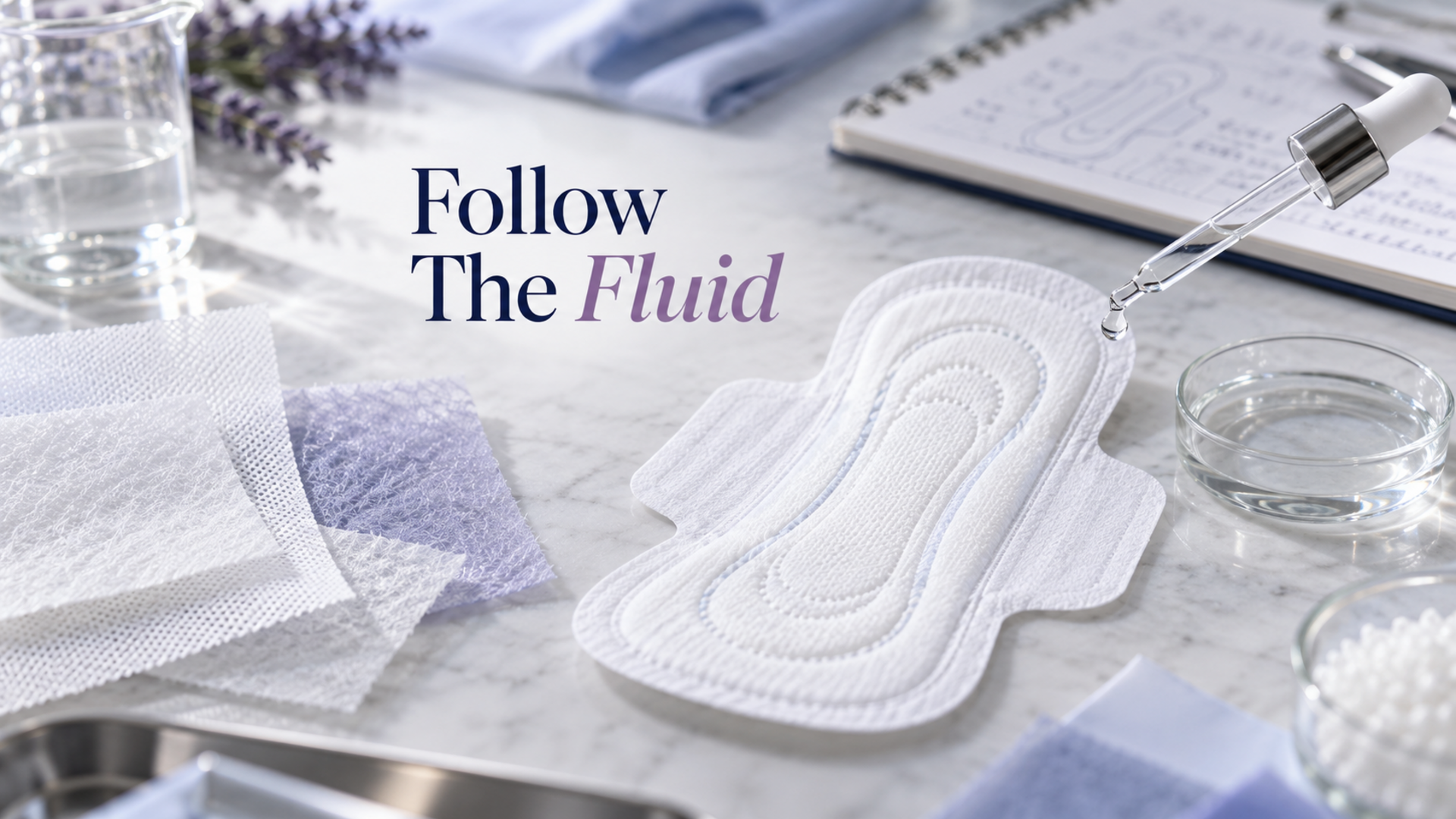
Follow the liquid through the product, then use a defined method to understand each part of the journey.
Discuss your product briefProduct-development guidance. Evaluation methods and acceptance criteria should be defined for the exact product, intended use and destination market.